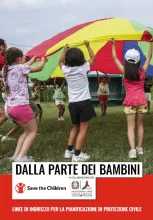
The guidelina addresses the need to protect children during emergencies, filling gaps in traditional civil protection plans. It results from interdisciplinary collaboration among pediatricians, psychologists, civil protection experts, and associations, and is informed by recent experiences in Italy and abroad. It helps municipalities and institutions implement specific measures for children and adolescents, promoting safety, educational continuity, psychological support, and active participation of minors, while respecting their rights and supporting community resilience.
Map
Dalla parte dei bambini - Linee di indirizzo per la pianificazione di protezione civile
General information
Save the Children Italia
In emergency situations, the rights of children and adolescents risk being violated, ignored, or underestimated due to the need to intervene quickly on aspects related to primary needs. Based on experience gained internationally and in national emergency contexts, Save the Children Italia offers practical recommendations to ensure safety, educational continuity, psychological support, and child participation, emphasizing respect for children’s rights and strengthening community resilience.
The guideline was developed in response to the growing recognition that traditional emergency management plans often overlook the specific needs of children and adolescents during emergencies. Increasingly frequent natural and climate-related events, pandemics, and social crises highlighted the need for targeted measures to protect minors. It is the product of interdisciplinary collaboration among pediatricians, psychologists, civil protection experts, and child-focused organizations, drawing on both Italian and international experiences. Its purpose is to guide municipalities and institutions in integrating child-centered measures, such as safety protocols, educational continuity, psychological support, and participatory approaches, into emergency planning, ensuring both the protection of children’s rights and the resilience of communities.
Status
Purpose
Topics For Preparedness
Needs Addressed
The guideline addresses the problem that traditional emergency planning and civil protection measures often overlook the specific needs of children and adolescents. As a result, minors are particularly vulnerable during disasters, pandemics, or social crises, facing risks to their safety, psychological well-being, education, and access to essential services. The guideline provides municipalities and institutions with practical recommendations to integrate child-centered measures into preparedness, response, and recovery, ensuring that children’s rights are protected and their specific vulnerabilities are addressed in all phases of emergency management.
All children and adolescents, with special attention to those in high-risk or marginalized situations.
The guideline provides municipalities and institutions with comprehensive, proactive guidance to protect children before, during, and after emergencies. It goes beyond basic awareness or minimal planning by offering structured recommendations, tools, and strategies to anticipate risks, assess vulnerabilities, and ensure children’s safety, education continuity, and psychological support. The focus on integrating child-centered measures across all phases of emergency management demonstrates a high level of preparedness planning tailored to a specific vulnerable group.
The guideline emphasizes adapting and preparing existing facilities, such as schools, shelters, and evacuation centers, to meet the specific needs of children and adolescents during emergencies. It provides practical recommendations to ensure these spaces are safe, accessible, and functional, supporting continuity of education, care, and protection. While it promotes substantial preparation, it does not require fully hazard-proof or resilient infrastructure.
The guideline emphasizes seeking input and feedback from children and adolescents during emergency planning. It ensures their perspectives are heard and considered, helping tailor preparedness and response measures to their specific needs, without implying full decision-making or partnership.
The guideline engages children and adolescents through consultative and participatory methods, such as workshops, surveys, focus groups, and school-based discussions. These activities are designed to gather their perspectives, needs, and concerns regarding emergencies and preparedness measures. While children do not have decision-making authority, their input helps ensure that planning and interventions are child-centered, relevant, and responsive to their specific vulnerabilities.
In the guideline, children and adolescents have an advisory role in emergency preparedness and response. Their perspectives are actively sought through consultations, workshops, surveys, and school-based discussions, ensuring that planners understand their needs, vulnerabilities, and priorities. However, the final decisions regarding emergency measures, resource allocation, and implementation remain with municipalities and institutions, reflecting the legal and practical responsibilities of authorities. This approach balances the importance of child-centered planning with the realities of governance and accountability, allowing children’s voices to meaningfully inform decisions without transferring formal authority to them. By embedding their input into planning processes, the guideline promotes empowerment through awareness, understanding, and consultation, while recognizing that ultimate decision-making must remain with trained professionals to ensure safety and effectiveness.
The guideline promotes moderate capacity-building and long-term empowerment by providing children and adolescents with knowledge, skills, and structured activities to understand risks, safety measures, and emergency procedures. Through workshops, school programs, and awareness initiatives, it helps them become more aware and prepared, fostering foundational skills that contribute to resilience over time. It lays the groundwork for future engagement and gradual empowerment, ensuring that children perspectives are considered in planning and that they are better equipped to respond safely in crises.
Hazard Type
Geographical Scope - Nuts
Geographical Scope
Population Size
Population Density
Vulnerable Groups
Governance
Emergency Preparedness
Infrastructure Readiness
Engagement Level
Empowerment Level
Implementation
The guideline introduces a child-focused, multi-hazard framework that addresses the specific needs and rights of children throughout all phases of emergencies. It offers practical tools and clear operational guidance to help municipalities adapt services, spaces, and procedures to ensure safety, continuity of care, and education. By using structured participatory methods, such as workshops, surveys, and school-based activities, it incorporates children’s perspectives into planning while strengthening their awareness and basic preparedness skills. Developed through collaboration among experts in child welfare, psychology, and civil protection, the guideline represents an innovative step in embedding child-centered measures into emergency management in Italy.
Italian
Save the Children Italia
Save the Children Italia has a high level of experience in Disaster Risk Management (DRM), particularly in supporting children during emergencies. More specifically, the work of the Emergecy Unit of Save the Children Italia spans all DRM phases: mitigation and prevention through disaster-risk education, preparedness via training and planning, response with immediate aid and psychosocial support, and recovery through safe spaces, education continuity, and child protection. They have extensive experience in national emergencies, such as the 2016–2017 Central Italy earthquakes, and collaborate closely with civil protection authorities. Additionally, they develop practical manuals and toolkits for frontline staff, demonstrating their capacity to translate DRM principles into actionable interventions for children in both acute and longer-term emergency contexts.
The actors involved include:
- Local Authorities / Municipalities: primary users of the guideline, responsible for integrating child-centered measures into local emergency plans.
- Civil Protection System: plays a key role in planning, coordination, and operational response, ensuring that children’s needs are considered in all phases of emergencies.
- Schools and Educational Institutions: central for preparedness, awareness activities, continuity of education, and for hosting consultation or training sessions with children.
- Social Services: upport vulnerable minors and families, ensure continuity of care, and collaborate during response and recovery phases.
- Health Services and Pediatric Professionals: provide medical expertise, support children’s physical and psychological well-being, and contribute to preparedness planning.
- Child-Focused Organizations: provide expertise, methodologies, training tools, and advocacy for child-centered emergency planning.
- Emergency Volunteers and NGOs: assist with community engagement, logistics, shelters, and child-friendly spaces.
- Children and Adolescents: engaged as participants through consultation and awareness activities, contributing their perspectives to preparedness and response planning.
- Families and Caregivers: essential for ensuring children’s safety, preparedness at the household level, and supporting recovery.
Implementation steps include:
- Identify gaps in how current emergency plans address children’s safety and well-being.
- Engage municipalities, civil protection, schools, social/health services, and child-focused organizations.
- Evaluate how hazards affect children and identify vulnerable groups.
- Adapt procedures, shelters, services, and communication to ensure protection and inclusion.
- Consult children through participatory activities and train professionals on child protection in emergencies.
- Integrate measures into official plans, conduct drills, gather feedback, and update plans regularly.
The guideline can be implemented relying primarily on existing municipal structures, schools, social and health services, and civil protection systems. It requires moderate local investment for staff time, workshops, training, minor infrastructure adaptations, and participatory activities. While external support from NGOs or other organizations can enhance implementation, the guideline is designed to be financially and operationally sustainable within local budgets.
The guideline spans the full emergency cycle, with a strong emphasis on preparedness, where municipalities assess children’s needs, coordinate local actors, adapt procedures and infrastructure, and involve children in participatory activities. During the response phase, it provides guidance to ensure children’s safety, maintain essential services, offer psychological first aid, and manage child-friendly shelters. In the early recovery phase, it supports the restoration of education, health, and social services while monitoring children’s well-being and helping families regain stability. Finally, in the long-term recovery phase, the guideline promotes continuous improvement by integrating lessons learned, updating emergency plans, reinforcing protection systems, and strengthening community resilience for future events.
Experience of the Implementing Organisation in DRM
Target Audience
Resources Required
Timeframe & Phases
Participation Results
A key challenge is that municipal emergency plans often overlook children’s specific needs, due to limited expertise, insufficient resources, or a lack of child-focused procedures. To address this, the guideline provides practical tools and checklists to help local authorities integrate child-centered actions without requiring major structural changes. Another challenge lies in coordination among multiple actors, schools, social services, health professionals, and civil protection, which can lead to fragmented responses. The guideline responds with structured coordination frameworks and clearly defined roles to streamline collaboration. Engaging children can also be difficult because of time constraints, varying ages, and different communication needs; the guideline mitigates this by offering age-appropriate participation methods to gather their views effectively. Finally, disparities in local capacity, such as limited training or infrastructure, pose obstacles, which the guideline addresses through capacity-building activities, adaptable procedures, and flexible implementation models that municipalities can tailor to their resources.
The guideline adopts a multi-hazard strategy, addressing a wide range of emergencies including disasters related to natural hazards, health crises, and social emergencies. It provides child-centered measures that can be applied across all phases of emergency management (preparedness, response, and early recovery) ensuring that children’s safety, well-being, and rights are systematically considered.
Risk & Mitigation Plan
Scalability and Sustainability
The guideline promotes sustainability by embedding child-centered measures into existing local emergency planning systems, rather than creating parallel structures. It focuses on capacity-building, training municipal staff, educators, and emergency responders to maintain child protection practices over time. Continuous monitoring, evaluation, and updating of plans ensure that lessons learned and best practices are institutionalized. The approach is resource-efficient and adaptable, allowing municipalities of varying sizes and capacities to integrate child-focused actions into long-term preparedness, response, and recovery strategies, ensuring ongoing resilience and protection for children in future emergencies.
The guideline is designed to be highly scalable and adaptable to different municipal contexts, sizes, and resource levels. Its recommendations, tools, and checklists can be applied in small towns or large cities, and tailored to local hazards, population characteristics, and infrastructure capacities. Child-centered measures, participatory activities, and training programs are flexible, allowing municipalities to implement them gradually or intensively depending on available resources. This adaptability ensures that the guideline remains relevant across diverse emergency scenarios and supports incremental improvements in preparedness, response, and recovery for children and adolescents.
The implementation of these guidelines primarily relies on structured tools, checklists, and participatory methods such as workshops, surveys, and school-based activities. While it promotes innovative approaches in child-centered planning and multi-hazard applicability, it does not incorporate advanced technological systems or smart adaptive solutions for real-time monitoring or response.
Direct costs are directly linked to specific actions outlined in the guideline. These costs include producing and distributing guidelines, checklists, and educational materials; conducting workshops, training sessions, and school-based activities; making minor infrastructure adaptations to shelters or schools; and purchasing basic tools or supplies needed for preparedness activities.
Operational costs include staff time for municipal personnel, social workers, educators, and emergency responders; continuous training and capacity-building; monitoring and updating emergency plans; maintaining adapted infrastructure and child-friendly spaces; and carrying out communication, awareness, and community engagement activities.