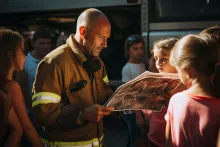
BFireSafe@School is a school-based fire safety education solution designed for post-primary students, helping teachers deliver consistent, age-appropriate fire safety learning that can be reused across different European contexts.
Map
BfireSafe@School
General Information
ISIG
A modular fire safety education programme for secondary schools that helps teachers build students’ practical knowledge and safer behaviour.
BFireSafe@School provides structured learning content (units/modules) supported by digital components (e-learning/LMS), enabling schools to integrate fire safety into classroom delivery in a consistent and repeatable way. It was developed through a multi-country consortium and is made available in multiple languages to support transferability across education systems.
Fire safety education in many European contexts has traditionally focused more on younger children, while post-primary students receive less consistent, structured provision. BFireSafe@School was created to address this gap through a shared European programme that can be implemented by schools and supported by fire services, enabling more consistent prevention messaging and safer behaviours among adolescents.
The project was created to respond to a documented inconsistency in post-primary fire safety provision across European contexts and the need for a common, school-usable approach that can be adapted and translated across countries. Its cross-country consortium structure reflects that the challenge is not local to one system but shared across education and public safety governance in multiple European settings.
Hazard Type
Geographical Scope - Nuts
Population Size
Population Density
Needs Addressed
Fire safety education in Europe is often uneven and tends to focus more on primary ages, leaving a gap in structured, age-appropriate learning for post-primary students (12–18). BFireSafe@School addresses this by providing a harmonised, teacher-led programme that schools can implement consistently, combining classroom delivery with digital learning and assessment tools. The solution aims to strengthen young people’s practical knowledge and safer behaviours (for themselves and others) in everyday settings where fire risk may arise.
The solution targets a specific age cohort rather than a vulnerability category.
Because this is a reusable education solution, it can be implemented under different governance arrangements depending on country context:
- Centralized: national fire safety / civil protection / education authorities endorse standard materials and promote adoption across school systems.
- Decentralized: individual schools, municipalities, or local education authorities adopt and embed the programme locally.
- Multistakeholder: implementation is strengthened when emergency services (fire services), education actors, and school communities coordinate on delivery, dissemination, and local adaptation.
This is a prevention/preparedness education programme solution rather than an operational response system.
Implementation does not require specialised emergency infrastructure. Minimum requirements are standard school delivery capacity (teachers, timetable space, basic classroom resources). Digital components (LMS/e-learning) improve consistency and measurability, but the programme can still be delivered with limited digital capacity by prioritising the teacher-led modules and using digital tools where feasible.
To equip students, families, and school communities with practical fire safety knowledge and safer behaviours through structured, age-appropriate learning.
Teacher-led classroom delivery supported by structured modules and digital learning components (e-learning and a learning management system) to reinforce learning and enable basic assessment of progress, alongside dissemination activities through partners and project channels.
Decision-making sits primarily with the project consortium and school/education implementers: the curriculum structure and tools are pre-designed, while schools/teachers can decide how to integrate the programme into subjects and how to deliver it locally. Students are the learning audience rather than decision-makers; their influence is mainly through participation and learning outcomes.
The solution builds long-term capacity by equipping teachers and students with a repeatable programme that can be delivered year-to-year. Digital delivery through the LMS supports continuity and basic measurability of learning progress. Multi-language availability and partner-country adaptation increase long-term scalability and sustained use across different school systems.
Vulnerable Groups
Governance
Emergency Preparedness
Engagement Level
Empowerment Level
Implementation
BFireSafe@School combines a teacher-led curriculum with digital learning to make fire safety education usable, scalable, and consistent across different European school settings. The programme is modular (10 units) and can be embedded into existing school subjects. It also includes technology-enabled learning elements (e-learning/LMS, and an AR component referenced in the brochure), supporting engagement and reinforcement beyond classroom delivery.
BFireSafe@School materials are currently available in 10 languages:
- English
- Irish
- Basque
- Danish
- Dutch
- Finnish
- French
- German
- Lithuanian
- Spanish
The solution is delivered as an Erasmus+ project output, led by a fire service / local authority partner (lead partner referenced publicly) and implemented through schools (teachers) with support from consortium partners. Originally developed through a European consortium, the solution can be implemented by:
- school systems and individual secondary schools,
- education authorities and teacher training bodies,
- fire and rescue services / civil protection agencies supporting prevention education,
- local government safety teams partnering with schools.
The programme was developed by an organization with practical emergency management expertise and demonstrated capacity to design, coordinate, and deliver DRRM-related projects across multi-stakeholder and cross-border contexts.
When implemented through fire services, civil protection, or public safety education authorities, organisational DRRM experience is typically high. When implemented mainly through schools, DRRM experience may be moderate, and the solution works best when schools are supported by emergency services or safety education partners to ensure technical accuracy and stronger integration into local DRRM arrangements.
- Project lead partner and consortium partners (fire services + education development partners across multiple EU countries)
- Schools (post-primary) and teachers (primary implementers)
- Students aged 12–18 (target group)
- Fire service personnel/fire officers (optional supporting role in delivery, depending on local arrangements)
- Digital platform / LMS administrators (where used)
- Access the programme materials (teacher resources + digital components) and identify where it fits in the school timetable/curriculum.
- Prepare delivery: select the relevant units, align to subjects (e.g., wellbeing/science/civic-type subjects), and decide whether to involve local fire service support.
- Deliver the modules in class (teacher-led) and reinforce learning with the e-learning/LMS content (tests/activities if used).
- Use the LMS (where applicable) to track learner progress and support repeat delivery across classes/years.
- Localise and adapt (language/context) for national use if deploying outside the original pilot context.
- Disseminate through school channels and partner networks to expand uptake (typical for EU education safety programmes).
- Staff time: teacher preparation and delivery time; school leadership support to schedule/approve
- Digital access: devices and internet access if using LMS/e-learning components
- Supporting partners: optional collaboration with local fire services/experts
- No specialist equipment required beyond normal school teaching infrastructure
- Project development phase: materials and tools developed during the Erasmus+ project period (the website outputs page shows development work packages and dates).
- Pilot/testing phase: the programme was pilot tested in schools before broader roll-out.
- Operational phase: once adopted, the programme can be delivered annually or integrated into recurring wellbeing/safety learning cycles.
Target Audience
Resources Required
Timeframe & Phases
Participation Results
- Make learning measurable to support credibility and adoption. The LMS approach is built to track progress and results, which helps teachers and partners understand whether learning is taking place.
- Keep the programme adaptable to school realities. A modular structure and curriculum-fit approach reduces friction for schools and supports repeated use over time.
- Build a feedback loop early. Participation in pilots and the request for user feedback indicate a “learn-and-improve” implementation approach rather than a fixed one-off package.
Rolling out a secondary-school programme across countries and education systems is challenging because curricula, timetables, teacher capacity, and digital access differ. The solution addresses this by using a modular structure that schools can integrate flexibly, and by offering multilingual materials so teachers can use content without heavy localisation work.
Another challenge is sustaining delivery beyond pilots. School programmes often depend on individual champions; uptake can drop if training and materials aren’t easy to reuse. The solution mitigates this by providing structured units and digital tools that support repeat delivery and basic tracking of learner progress.
A further challenge is consistency and credibility: fire safety content must be accurate and aligned with local guidance. The solution is therefore best implemented with support from fire services or safety education partners, especially when adapting across governance contexts.
A key implementation risk is low adoption or uneven uptake across schools. This can be mitigated by making the programme easy to fit into existing subjects, providing ready-to-use modules, and supporting dissemination through education authorities and partner networks.
Another risk is digital inequality: schools may have limited devices or unreliable connectivity, reducing the usefulness of LMS-based components. Mitigation is to treat the programme as teacher-led by default and use digital tools as an enhancement where feasible.
A third risk is content localisation: fire safety practices and emergency numbers can differ by country, and outdated guidance can undermine credibility. Mitigation measures include local partner validation (e.g., fire services), periodic review, and clear localisation guidance for implementers.
Risk & Mitigation Plan
Scalability and Sustainability
BFireSafe@School was developed through external project funding (Erasmus+), and the sustainability pathway appears to rely on continued use by schools and fire/community safety stakeholders using the completed outputs (teaching materials + LMS/e-learning tools). Long-term sustainability depends on (1) keeping materials discoverable and accessible, (2) maintaining/hosting the digital components, and (3) periodic updates to keep the content aligned with evolving safety guidance and education needs. Public information does not clearly specify who funds or governs ongoing maintenance post-project.
The solution is highly scalable because it is designed as a reusable school programme, supported by digital delivery and a multilingual approach. It is adaptable because:
- schools can integrate it into different subjects and timetables,
- partners can localise delivery according to national education and public safety arrangements,
- the “teacher-led + optional fire officer support” model fits a variety of governance contexts.
Technology plays a meaningful support role: the programme includes a Learning Management System intended to make results measurable and provide easy access to materials, plus e-learning content (and an AR component referenced in the brochure). This is technology-enabled education rather than an “advanced smart” operational DRRM system.
No data was available regarding direct costs for programme development in the reviewed material. From the analysis, it can be inferred that for adopters, direct costs are typically low-to-moderate and may include teacher onboarding/training time, printing of learning materials, translation/localisation where needed, and any initial setup of digital learning tools.
Operational costs are mainly ongoing staff time: repeat delivery each school year, refresher training, coordination with partners (especially fire services), maintaining/updating digital content where used, and periodic content updates to remain aligned with evolving guidance.
- Multilingual delivery is a scaling accelerator.
Making the programme available in multiple languages reduces barriers to adoption across countries and increases the likelihood of sustained use beyond the original pilot context. - Modular curriculum design makes adaptation realistic.
A module-based programme can be integrated into different national curricula and school timetables, which supports both initial uptake and long-term repeat delivery. - Digital platforms improve consistency but create a maintenance dependency.
An LMS/e-learning approach supports repeatability, accessibility, and basic measurability of learning. However, sustainability depends on who maintains hosting, content updates, and user support after project funding ends. Public sources do not clearly specify a long-term maintenance owner or budget, so continued operational sustainability may depend on partner institutions continuing to host and refresh the platform. - Teacher-led implementation improves sustainability when fire services are capacity-limited.
A model that can be delivered primarily by teachers (with optional support from fire officers) reduces reliance on external personnel and increases the chance the programme becomes embedded in routine school delivery.