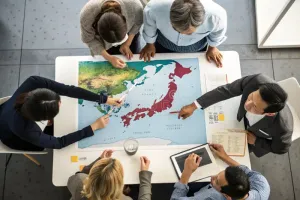
After the 1995 Kobe earthquake, residents of North Rokko used the participatory Machizukuri model to create alternative reconstruction plans, forming neighbourhood associations that strengthened community resilience and civic engagement.
Decentralised

Structured collaboration among stakeholders to enhance community resilience
Case
A low-cost network of sensors built from open hardware that sends flood and mudflow alerts to officials and community leaders in Chosica, Peru.
Contribution
A five-step method for building flood early warning systems with local communities, municipalities and national weather and civil defence services in the Andes.
It was developed by CIIFEN, the International Research Centre on El Niño, under the regional programme PRASDES, which Finland’s foreign ministry financed. It joins the four components of early warning set out by the UN disaster-reduction office to an approach of the Organization of American States in which trained community volunteers operate simple rain and river-level instruments.
Contribution
In 2015-2016, residents of 19 communities in Escoma, Bolivia, mapped flood-prone areas with the municipality to build a local flood early warning system.
Contribution
A community flood early warning system was built in Querecotillo, Peru, in 2016, with residents mapping flood zones and rehearsing an evacuation drill. CIIFEN worked with the municipality, the civil defence institute INDECI and the weather service SENAMHI between January and September 2016.
Contribution
The Zambia Red Cross acted on a flood forecast in January 2023 to warn and equip households in Kitwe and Kafue before the water arrived.
Contribution

A free, curriculum-linked first aid teaching toolkit that enables any secondary school teacher across the UK to deliver first aid education to students.
Case

An immersive game-based learning experience that teaches disaster risk reduction and climate adaptation through collaborative problem-solving. Participants work together in a three-room installation to solve quizzes and puzzles to make their simulated community more resilient to natural hazards.
Solution
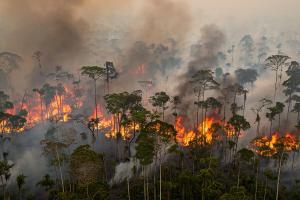
A post-wildfire recovery initiative that mobilized conservation corps youth as a trained, paid workforce to support environmental and community recovery in fire-affected areas of Los Angeles County.
Case