A low-cost network of sensors built from open hardware that sends flood and mudflow alerts to officials and community leaders in Chosica, Peru.
Basic Preparedness
A five-step method for building flood early warning systems with local communities, municipalities and national weather and civil defence services in the Andes.
It was developed by CIIFEN, the International Research Centre on El Niño, under the regional programme PRASDES, which Finland’s foreign ministry financed. It joins the four components of early warning set out by the UN disaster-reduction office to an approach of the Organization of American States in which trained community volunteers operate simple rain and river-level instruments.
Contribution
In 2015-2016, residents of 19 communities in Escoma, Bolivia, mapped flood-prone areas with the municipality to build a local flood early warning system.
Contribution
A community flood early warning system was built in Querecotillo, Peru, in 2016, with residents mapping flood zones and rehearsing an evacuation drill. CIIFEN worked with the municipality, the civil defence institute INDECI and the weather service SENAMHI between January and September 2016.
Contribution
Residents of two flood-prone communities in Chad described how they already warn each other and prepare for floods, and what support they want.
Contribution
Before the 2024/25 drought season, farmers in Mbire, Zimbabwe, helped plan and build water and livestock protection measures with Welthungerhilfe and its local partner.
Contribution

“Mettiamoci al sicuro — Conto su di te” (“Let’s Get to Safety — I’m Counting on You”) is a Civil Protection project designed for schools to teach children and young people how to behave in emergency situations. It was created out of the need to talk about safety in a simple, positive, and non-alarming way.
Case
“Mettiamoci al sicuro — Conto su di te” (“Let’s Get to Safety — I’m Counting on You”) is a Civil Protection project designed for schools to teach children and young people how to behave in emergency situations. It was created out of the need to talk about safety in a simple, positive, and non-alarming way.
Contribution

An immersive game-based learning experience that teaches disaster risk reduction and climate adaptation through collaborative problem-solving. Participants work together in a three-room installation to solve quizzes and puzzles to make their simulated community more resilient to natural hazards.
Solution
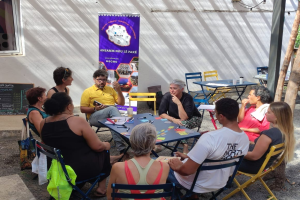
Cette démarche s’inspire de l’expérience québécoise du Regroupement des Organismes Humanitaires et Communautaires pour les Mesures d’Urgence à Montréal (ROHCMUM). Les outils de préparation aux situations d’urgence développés par l’AFPCNT, associés à des ateliers collectifs, permettent aux associations réunionnaises volontaires de réaliser leur Plan de mesures d’urgence et de solidarité.
Contribution