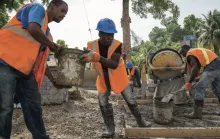
The approach is designed to reduce disaster risk by strengthening local capacities, integrating community knowledge into risk analysis, and embedding preparedness and mitigation actions within broader humanitarian and development programming. It is not a single project but a structured methodology applied across multiple hazard contexts and countries.
Map
Community-Based Disaster Risk Reduction (CBDRR) Approach
General information
The CBDRR approach developed by Solidarités International is a participatory methodology that places affected communities at the centre of disaster risk analysis, planning, and action. It combines local knowledge with technical expertise to identify hazards, vulnerabilities, and capacities, and translates this shared analysis into concrete preparedness, mitigation, and response measures implemented at community level.
The approach emerged from repeated operational evidence that top-down risk reduction measures often fail to reflect local realities, particularly in fragile and hazard-prone contexts. Solidarités International observed that disaster impacts were exacerbated by weak local ownership, limited understanding of risk dynamics, and insufficient integration between humanitarian response and long-term resilience. CBDRR was therefore developed to bridge emergency action and development by embedding risk reduction into everyday community practices and governance structures.
Status
Purpose
Topics For Preparedness
Geographical Scope - Nuts
Population Size
Population Density
Needs Addressed
The case addresses the recurrent exposure of vulnerable communities to natural hazards in contexts where institutional capacity is weak and where risk reduction measures are often externally designed and poorly appropriated. The report shows that without meaningful participation, early warning, preparedness plans, and mitigation infrastructure tend to be underused or abandoned. The approach ensures that risk analysis and decision-making are rooted in community priorities, social organisation, and lived experience.
Disaster impacts are unevenly distributed within communities. Elderly people, children, people with disabilities, and households with limited resources are disproportionately affected due to mobility constraints, access barriers, and social isolation. CBDRR explicitly integrates these groups into risk mapping and planning processes to ensure that preparedness and response measures reflect differentiated needs.
Governance under the CBDRR approach is structured around community committees or representative groups that work in coordination with local authorities and technical services. While ultimate responsibility for disaster management may remain with state institutions, the approach strengthens downward accountability and local decision-making by recognising communities as legitimate actors in risk governance.
In many intervention areas, formal disaster plans exist but are weakly operationalised. CBDRR enhances preparedness by translating abstract plans into locally understood actions, such as evacuation routes, safe shelters, alert mechanisms, and role distribution, validated and rehearsed by community members.
Infrastructure in target areas (primarily in the Global South) is often minimal and poorly maintained. CBDRR does not primarily focus on large-scale infrastructure, but on small, locally manageable measures such as raised water points, drainage maintenance, safe storage areas, and clearly identified safe locations, ensuring feasibility and sustainability.
Engagement aims to ensure that communities are not passive recipients of risk information but active co-producers of risk knowledge and solutions. Participation builds shared understanding of hazards, strengthens trust between communities and institutions, and creates collective responsibility for preparedness and mitigation actions.
Participatory risk assessments, hazard and vulnerability mapping, seasonal calendars, focus group discussions, simulation exercises, and community planning workshops are core engagement tools.
Communities directly influence the identification of priority risks, the selection of mitigation measures, and the design of preparedness plans. Decisions are taken collectively and are formally documented, increasing accountability and continuity beyond individual projects.
CBDRR builds long-term capacity by transferring analytical skills, strengthening local organisational structures, and embedding disaster risk considerations into everyday decision-making. The report stresses that empowerment is achieved not through one-off trainings, but through iterative learning, practice, and reinforcement over time.
Vulnerable Groups
Governance
Emergency Preparedness
Infrastructure Readiness
Engagement Level
Empowerment Level
Implementation
The main innovation lies in the systematic integration of community knowledge with technical risk analysis, and in the positioning of CBDRR as a bridge between emergency response and development programming. The approach is flexible, adaptable to multiple hazards, and designed to function in fragile governance contexts.
English, French, local languages (context-dependent)
Solidarités International
SOLIDARITÉS INTERNATIONAL has decades of experience in humanitarian response, resilience, and disaster risk management across highly vulnerable contexts. The report reflects accumulated institutional learning rather than a pilot initiative.
Community representatives, local authorities, technical services, civil society organisations, and SOLIDARITÉS INTERNATIONAL field teams.
Implementation follows a structured sequence: initial context analysis, participatory risk assessment, joint prioritisation of actions, development of community preparedness and mitigation plans, implementation of agreed measures, and periodic review and adaptation.
The approach relies on trained facilitators, modest financial resources for community-led actions, technical support for risk analysis, and sustained engagement over time. External funding is typically required in early phases, with increasing local ownership as capacities develop.
CBDRR is implemented over medium to long-term cycles, aligned with multi-year programmes. Monitoring and learning are embedded throughout implementation to allow adaptation to evolving risks.
Experience of the Implementing Organisation in DRM
Target Audience
Resources Required
Timeframe & Phases
Participation Results
Challenges include unequal participation, initial community scepticism, and the difficulty of sustaining engagement after project closure.
Challenges are addressed through inclusive facilitation, transparent decision-making, and alignment with existing local structures rather than creating parallel systems.
Risk & Mitigation Plan
Scalability and Sustainability
Sustainability is achieved through the integration of CBDRR into local governance practices and community routines, rather than through continued external presence. Lasting impact depends on institutional anchoring and social cohesion.
The methodology is highly adaptable across hazards and contexts, provided that facilitation methods and timelines are adjusted to local social and institutional conditions. Scalability is conceptual rather than programmatic: principles are transferred, not rigid models.
Technology plays a supporting role, mainly through simple tools for mapping, communication, and early warning. The emphasis remains on human processes rather than digital systems.
Aggregated cost figures cannot be found, but based on described activities, direct costs are primarily linked to facilitation, training sessions, community meetings, and small-scale mitigation works, generally low compared to infrastructure-heavy interventions.
Operational costs mainly concern continued facilitation, periodic reviews, and community-led maintenance of preparedness measures. These are intentionally kept low to remain compatible with local capacities.
The central lesson is that disaster risk reduction is most effective when communities understand, own, and continuously update their risk strategies. Technical solutions alone are insufficient without social processes that build trust, legitimacy, and shared responsibility.