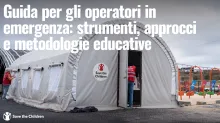
This manual was created with the aim of practically and concretely supporting all practitioners who operate in emergency contexts in carrying out educational activities with children and adolescents affected by crises. An emergency, by its sudden and disruptive nature, significantly alters daily life and the continuity of educational interventions; it therefore becomes essential to restore routines and the psycho-physical well-being of the children involved. This manual is intended as a collection of recommendations, methodological insights, suggestions, and practical, experiential educational activities that Save the Children Italy staff have tested in past emergency responses in Italy.
Map
Guida per gli operatori in emergenza: strumenti, approcci e metodologie educative
General information
Save the Children Italia
This manual represents a practical and concrete support to all operators working in emergency settings in carrying out educational activities with children and adolescents in emergency situations.
Due to its sudden nature, an emergency disrupts and significantly alters the daily life and linearity of educational interventions. It is therefore crucial to restore routine and the psycho-physical well-being of the children involved.
This manual aims to be a collection of advice, methodological insights, suggestions, and practical-experiential educational activities previously tested by Save the Children Italia operators during emergency responses in Italy.
The manual sits within a broader global effort to ensure that children’s rights are protected during emergencies. Over the past two decades, international organizations, humanitarian agencies, and educational networks have increasingly recognized that crises (wars, disasters, displacement, social emergencies) do not just threaten physical safety; they also severely disrupt learning, emotional stability, and children's sense of normality. Drawing on its long experience in humanitarian response and child protection, Save the Children Italy created this manual to fill a gap: frontline workers often have to operate in chaotic conditions without structured guidance on how to support children’s learning and emotional needs. The guide provides them with a shared language, core principles, and practical tools so that educational and psychosocial activities can continue even in temporary shelters, informal spaces, or rapidly changing contexts. The background assumption is that education in emergencies is life-saving in a broader sense. It restores routine, offers emotional containment, strengthens resilience, and creates safe environments where children can process stress and trauma.
Needs Addressed
The manual addresses the disruption that emergencies cause to children’s daily lives, routines, and emotional well-being. It provides operators with practical guidance, tools, and activities that restore structure, normality, and safety for children and adolescents. The manual supports the continuation of education, promotes psychosocial well-being, fosters resilience, and safeguards children’s rights, even in the most challenging emergency contexts.
The manual specifically addresses children and adolescents who are affected by emergencies.
The manual is designed for use in both immediate and ongoing emergency contexts, making it suitable for operators who are actively working in or preparing for rapid-response situations. It assumes that users have some familiarity with working with children, but does not require specialized training in emergency education or psychosocial support, making it accessible to a wide range of practitioners, including educators, social workers, and volunteers. The content is adaptable to different phases of an emergency, from the acute response to stabilization and recovery, supporting continuity of care and education. Overall, the manual provides practical, hands-on guidance that allows frontline operators to respond effectively to children’s needs without requiring high-level technical expertise.
The manual is designed to be flexible and adaptable to varying levels of infrastructure, recognizing that emergency contexts often involve disrupted or limited facilities. It can be used in temporary or improvised spaces such as tents, shelters, community centers, or open-air areas, and the activities it proposes are low-cost, easily replicable, and do not rely on specialized equipment or technology. While the manual’s guidance can be enhanced in better-equipped environments like schools or classrooms, it does not depend on them, allowing frontline operators to deliver effective educational and psychosocial support even in resource-limited or unstable settings.
The level of engagement described in the manual is best characterized as Dialogue. The manual emphasizes active participation, where children are encouraged to express their feelings, make choices within activities, and interact with both peers and facilitators. This goes beyond simply providing information, fostering two-way communication and meaningful interaction. While children do not have full decision-making authority over program design their voices and perspectives are actively included, making the engagement primarily interactive and participatory.
The manual uses a child-centered, activity-based method of engagement, where children and adolescents actively participate in educational, recreational, and psychosocial activities. Through play, creative expression, group work, storytelling, and experiential exercises, the approach encourages interaction, communication, and reflection. Rather than passive learning, it emphasizes hands-on, participatory experiences that support emotional expression, social connection, resilience, and a sense of agency, helping children navigate and cope with emergency contexts.
The degree of influence and decision-making in the manual is limited to guided participation. Children and adolescents are encouraged to express preferences, make choices within activities, and contribute to group discussions, giving them meaningful input and a sense of agency. However, they do not have authority over the design, planning, or strategic decisions of the educational programs, which remain the responsibility of operators and facilitators. Overall, the manual promotes participatory engagement within structured frameworks, balancing children’s input with the need for safety, structure, and program objectives.
The manual supports short-term capacity-building and empowerment by helping children develop resilience, social-emotional skills, and coping strategies, while strengthening operators’ skills in emergency education. Although it does not provide long-term decision-making power or systemic change, it lays a foundation for future empowerment through follow-up programs and continued educational support.
Hazard Type
Geographical Scope - Nuts
Geographical Scope
Population Size
Population Density
Vulnerable Groups
Governance
Emergency Preparedness
Infrastructure Readiness
Engagement Level
Empowerment Level
Implementation
The manual’s key features and innovations lie in its child-centered, participatory, and activity-based approach, which actively engages children and adolescents through play, creative expression, storytelling, and experiential exercises to promote learning, psychosocial well-being, and resilience. It is flexible and adaptable, usable across different emergency contexts and throughout all phases of a crisis. It integrates education with psychosocial support, emphasizing the interconnection of learning, protection, and well-being. It provides practical, field-tested tools such as worksheets and step-by-step activity guides, drawn from Save the Children Itallia’s experience in real emergencies, and is accessible to a wide range of practitioners without requiring specialized expertise. Overall, it focuses on restoring routine, safety, and stability, helping children cope with trauma and rebuild a sense of normality in challenging contexts.
Italian
Save the Children Italia
Save the Children Italia has a high level of experience in Disaster Risk Management (DRM), particularly in supporting children during emergencies. More specifically, the work of the Emergecy Unit of Save the Children Italia spans all DRM phases: mitigation and prevention through disaster-risk education, preparedness via training and planning, response with immediate aid and psychosocial support, and recovery through safe spaces, education continuity, and child protection. They have extensive experience in national emergencies, such as the 2016–2017 Central Italy earthquakes, and collaborate closely with civil protection authorities. Additionally, they develop practical manuals and toolkits for frontline staff, demonstrating their capacity to translate DRM principles into actionable interventions for children in both acute and longer-term emergency contexts.
The actors involved include:
- Frontline practitioners: educators, social workers, animators, and volunteers who directly deliver educational, recreational, and psychosocial activities to children and adolescents in emergency contexts.
- Community-based organizations and local NGOs: which may support the implementation of activities and provide access to spaces or resources.
- Child protection and education specialists: who contribute methodological guidance and ensure that activities align with best practices in emergency education and child safeguarding.
- Children and adolescents themselves: as active participants, whose engagement and input are central to the manual’s activities.
Implementation steps include:
- Evaluate the emergency context, children’s needs, available spaces, and resources; set up safe and accessible areas for activities.
- Create a safe, inclusive environment; establish routines and build trust to help children feel secure.
- Select or modify activities from the manual according to children’s ages, needs, and the current phase of the emergency, integrating educational and psychosocial goals.
- Facilitate structured educational, recreational, and psychosocial exercises that encourage participation, expression, and interaction.
- Observe children’s engagement and well-being, and adapt activities as needed based on feedback and evolving conditions.
- Prepare children for the next phase, such as reintegration into school or community programs, and document lessons learned for continuity and future interventions.
The manual is designed to be implemented in emergency contexts with minimal but essential external resources, such as basic materials for activities (paper, crayons, balls, craft supplies) and temporary spaces for safe activities. It does not require fully equipped facilities or long-term infrastructure, but some external inputs (e.g. supplies, staff support, and coordination) are necessary for effective delivery. Its design allows for rapid deployment even in resource-constrained settings.
The manual is designed to be applied across all phases of an emergency, supporting children and operators throughout the entire timeframe of a crisis. During the acute phase, it focuses on stabilizing children, providing safe spaces, restoring routines, and addressing urgent psychosocial and educational needs. In the stabilization or transition phase, activities aim to rebuild a sense of normality, continue learning, strengthen social connections, and promote coping skills. In the recovery or longer-term phase, the manual supports the continuity of education and psychosocial development, facilitates reintegration into formal schooling or community life, and lays the foundation for resilience and long-term empowerment. Its flexible design allows operators to adapt activities to the evolving conditions of the emergency.
Experience of the Implementing Organisation in DRM
Target Audience
Resources Required
Timeframe & Phases
Participation Results
The key lessons learned from the manual highlight that successful emergency education relies on flexibility and adaptability, using activities that can be easily modified to fit available spaces, materials, and the changing needs of children. Child-centered approaches, such as games, storytelling, and creative exercises, help children feel engaged and supported emotionally. Establishing simple routines and predictable activities provides a sense of normality and safety. Practical tools like ready-to-use worksheets and step-by-step activity guides allow even less experienced operators to implement programs effectively. Supporting staff through on-the-job guidance and mentoring ensures quality delivery, while integrating educational and psychosocial elements helps children build coping skills and resilience. Finally, adapting activities to local cultural and contextual realities improves participation and inclusivity, ensuring interventions are relevant and impactful in each unique emergency setting.
Implementing the manual can face several challenges, including limited resources and infrastructure, rapidly changing conditions, high levels of stress and trauma among children, diverse needs and vulnerabilities, and varying levels of staff experience in emergency education and psychosocial support. To address these challenges, the manual promotes adaptive strategies such as using flexible, low-resource activities, establishing safe, structured, and inclusive spaces, and adjusting activities to the evolving context and cultural considerations. It also encourages differentiated approaches tailored to children’s ages, abilities, and special needs, and provides clear guidance and on-the-job mentoring to support less experienced staff.
Risk & Mitigation Plan
Scalability and Sustainability
Although the manual does not create systemic change on its own, its flexible, adaptable tools and methodologies can be replicated, scaled, and integrated into local preparedness or child protection frameworks, supporting ongoing resilience and continuity of care.
The manual demonstrates high scalability and adaptability, making it suitable for a wide range of emergency contexts and operational capacities. Its activities are flexible and low-resource, allowing operators to implement them in diverse settings regardless of available infrastructure. The tools and worksheets are modular and easily adjustable to different age groups, cultural contexts, and levels of psychosocial vulnerability. This adaptability enables the manual to be scaled up across multiple sites or repeated in successive emergencies, while maintaining relevance and effectiveness. The manual provides a practical framework that can be tailored to local needs and rapidly deployed in both small- and large-scale emergency responses.
The manual is low-tech and hands-on, designed for use in resource-constrained emergency contexts. Activities rely on simple materials, worksheets, and step-by-step guidance rather than digital tools or advanced technology. It does not require developed technologies or smart adaptive solutions. Its innovation lies in practical, field-tested methodologies and adaptable activity design rather than in technological integration.
Direct Costs include basic materials for activities such as paper, crayons, balls, or simple craft supplies. These are minimal, inexpensive, and easily sourced locally.
Operational Costs cover staff time, training or mentoring for operators, and logistical arrangements such as setting up safe activity spaces. Costs are flexible depending on the size of the operation and the available infrastructure.