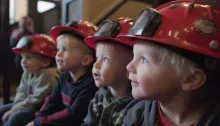
A municipal fire brigade in Germany created a digital puppet-based video series to continue fire safety education for young children when in-person visits to kindergartens and schools were disrupted.
Map
Rudi Ratte - a Puppet for Fire Safety
General Information
ISIG
A short video series that teaches kindergarten-age children fire safety through a puppet character and simple, memorable stories.
The episodes explain practical fire prevention and safe behaviour in a child-friendly way and introduce the role of firefighters, fire station equipment, and what happens during an emergency. The series is published online so educators and families can use it repeatedly in classrooms or at home.
During the COVID-19 period, the fire brigade could no longer run its usual in-person fire safety education visits for kindergartens and schools. As an alternative, the project team chose the internet as the most viable channel and partnered with puppet practitioners to make the content age-appropriate and engaging. A city-level survey of kindergartens indicated that children especially missed the experience of visiting the fire station and seeing vehicles and protective equipment, which shaped the content focus of the early episodes.
Hazard Type
Geographical Scope - Nuts
Population Size
Population Density
Needs Addressed
Early-years fire safety education normally relies on in-person visits (children visiting the fire station or firefighters visiting kindergartens). During the COVID period this became impossible, as kindergarten visits and on-site activities were paused, creating an immediate gap in prevention education for children. The project addressed that gap by selecting the internet as the best medium and developed child-friendly, digital fire safety education through short video episodes featuring puppet characters that explain the fire brigade’s work, safe behaviour in a fire, and how emergency response works.
A local survey of municipal kindergartens also indicated that children most missed the experience of visiting the fire station, seeing the key vehicles, and learning about protective equipment, therefore episodes were shaped around “bringing the fire station to them” digitally.
The case targets children, especially pre-school age.
This case is led and implemented by a public emergency service (a municipal fire brigade) that designs and delivers the content, with support from creative/education partners. Decision-making sits with the fire brigade as the accountable public authority.
This is a prevention / preparedness education intervention.
Requires only basic digital access (screen + internet) to use the videos; no specialist infrastructure.
To reach children and caregivers with fire safety messages in an engaging format and keep prevention education available when in-person outreach is limited.
Short online videos using puppetry and visual demonstrations, distributed publicly so educators and families can watch, repeat, and share.
Decision-making sits with the municipal fire brigade and its project team (topics, scripts, production), with creative input from puppet and education partners. Kindergartens/educators and families influence the content indirectly through feedback and questions.
The case strengthens long-term preparedness by creating reusable learning content that educators and caregivers can return to repeatedly, helping children internalise simple safety rules and normalising early-years risk awareness.
Vulnerable Groups
Governance
Emergency Preparedness
Infrastructure Readiness
Engagement Level
Empowerment Level
Implementation
- Child-friendly risk education: fire safety is taught through puppet storytelling, which keeps attention high and makes abstract safety rules memorable for young children.
- Digital-first delivery: content is published as a YouTube video series/playlist, enabling easy access at home or in kindergarten/school settings.
- Reusable micro-learning: episodes can be used repeatedly (e.g., as a short classroom activity, home activity, or refresher) without needing firefighters onsite.
- Accessible design: the series is described as usable even beyond local and national boundaries, and automatic subtitles broaden accessibility for some learners.
German
Primary implementer: Paderborn Fire Brigade
Supporting partners: Paderborn puppet theatre and local kindergarten/school stakeholders who use the materials in practice.
In other contexts, a similar case could be implemented by:
- municipal or regional fire and rescue services,
- civil protection / emergency management agencies with public education mandates,
- education authorities or school networks working in partnership with emergency services, and
- NGOs focused on child safety and risk education (ideally co-delivered with emergency services to ensure technical accuracy).
Paderborn Fire Brigade has high practical experience in disaster risk management and emergency response, as a professional emergency service responsible for fire suppression, rescue, and community fire prevention/education in its jurisdiction. In this case, that operational experience is translated into risk communication for children, with content validated and delivered by the fire service and adapted to early-years learning through collaboration with puppet/education practitioners.
- Fire brigade project team (content planning, safety messaging, operational accuracy)
- Puppet practitioners / theatre partner (creative design, performance, child-appropriate framing)
- Kindergarten/school staff (use and integration into learning routines)
- Parents/caregivers (home use)
- Platform host (YouTube as distribution channel)
- Identify the audience need and learning gaps (loss of in-person fire education; what children miss/need to see).
- Co-develop scripts and episode topics that translate core safety messages into child-appropriate scenarios.
- Produce short video episodes (puppet scenes + fire service explanations/visuals).
- Publish episodes in a structured playlist on YouTube for free access.
- Encourage use by kindergartens/educators and caregivers; collect questions/feedback informally to guide future episodes.
- Continue producing new episodes when new needs emerge or when updates are required.
- People/time: fire brigade staff time for content planning/validation; puppet practitioners for production and performance; basic coordination.
- Production capacity: basic filming/editing setup (can be low-cost, but requires consistent capability).
- Digital infrastructure: internet access and a device for viewing; a distribution platform (YouTube).
- No specialist response infrastructure is required for users.
- Initiation (COVID disruption): shift from on-site education to remote format.
- Production & release: creation of multiple episodes and publication as a playlist.
- Continuation/sustainment: ongoing publication of additional short videos beyond the initial disruption period (as described in sector write-ups).
Experience of the Implementing Organisation in DRM
Target Audience
Resources Required
Timeframe & Phases
Participation Results
- Digital risk education can maintain continuity when in-person outreach is disrupted, especially for early-years audiences.
- Child engagement improves when emergency services partner with educators/creative practitioners who can translate technical safety content into age-appropriate storytelling.
- Low-barrier distribution increases participation, but it makes outcome measurement harder (no public evaluation results were found beyond reach/uptake described in public write-ups).
Keeping children’s attention and translating safety rules into something they will actually remember is a challenge in any early-years safety programme. The project addresses this by using puppet storytelling, short episodes, and repeated simple messages.
A second challenge is reach and continuity: during disruptions (like COVID), schools may not be able to host visits, and families’ time and attention vary widely. Publishing the content online makes it easy to access in different settings (classroom or home) and allows repetition without needing firefighters onsite.
A third challenge is inclusivity. Not every household or classroom has the same level of digital access, and not all children learn the same way. A practical adaptation is to keep episodes short, visual, and suitable for group viewing, so they can be used flexibly (e.g., projected in a classroom, shared by teachers, or watched with parents).
1. Low uptake—educators or families may not discover the videos or may not prioritise them. This can be mitigated by partnering with kindergartens/schools, using municipal communication channels, and packaging episodes as ready-to-use lesson moments (short, clear, repeatable).
2. Unequal access: some users may have limited internet or devices. This can be mitigated by designing content that works in low-tech settings (downloadable/streamable on basic devices, suitable for group viewing, and supported by simple offline discussion prompts shared by educators).
3. Message dilution or misunderstanding when content spreads informally online. This can be mitigated by keeping messages consistent with official fire safety guidance, using clear “do/don’t” rules, and maintaining the series under an identifiable official channel.
4. Sustainability risk: production requires staff time and creative capacity. This can be mitigated by keeping the format lightweight (short episodes), reusing sets/characters, and building a small production routine that does not overload emergency service staff.
Risk & Mitigation Plan
Scalability and Sustainability
This case uses a low-infrastructure sustainability model: once produced, the video episodes remain publicly accessible online and can be reused by kindergartens, educators, and families with minimal additional cost. Sustainability therefore depends less on technology procurement and more on institutional ownership and capacity, i.e., whether the fire brigade (and its creative partners) continue to allocate staff time for occasional new episodes, updates, and channel maintenance. The model is strengthened by the fact that the content is designed for repeat use and can remain relevant beyond the original disruption that triggered its creation, but public sources do not specify a dedicated long-term budget or formal maintenance plan.
The case is highly scalable because the main outputs are short videos distributed online. Once produced, the content can be used repeatedly by many educators and families with minimal marginal cost, and can reach beyond the local jurisdiction.
The approach is adaptable across settings because it relies on a repeatable format (episodes + characters) that can be tailored to different age groups, school contexts, and local emergency numbers/procedures. It is also adaptable cross-border if subtitles/dubbing are added and content is localized to local emergency guidance.
Innovation is primarily methodological + delivery-channel: puppet pedagogy combined with digital distribution (YouTube playlist), enabling engaging safety education at scale.
No direct costs overview was found in the reviewed material (e.g., production equipment, contracted creative services, staff time).
No operational costs overview was found in the reviewed material (ongoing production, channel management, updates).
- Reusable digital assets are a long-term sustainability lever: once created, episodes can be replayed year after year in education settings.
- Sustainability hinges on ownership for upkeep: a simple YouTube-based model reduces infrastructure needs, but continued relevance depends on who maintains updates and responds to changing guidance.
- Partnerships reduce burden: collaboration with creative/education partners can make production feasible without overloading emergency service staff time.