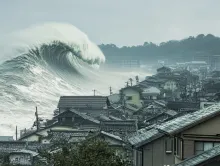
The regional school tsunami project was initiated in 2017 by the Japanese government in collaboration with the United Nations to prepare the Japanese society for future tsunamis. After suffering a great tsunami in 2011, Japan sought to increase the general tsunami preparedness in society. Teachers and school administrators from over 300 schools have been trained in tsunami preparedness. A key aspect of the program was to implement emergency drills in order to enhance evacuation behaviour during disasters. The emergency drills assisted schools in drafting evacuation plans, made evacuation routes safer and contributed to the procurement of essential items. It also may facilitate sharing the consensus and confidence on evacuation policy among community members as well as reduce delays, risk of drowning and casualties in the next catastrophe.
Map
Regional School Tsunami Project
General Information
ISIG
The Regional Tsunami Project is a regional initiative launched in 2017 by UNDP with funding from the Government of Japan to strengthen tsunami preparedness in schools and communities across the Asia-Pacific. The project works with governments and school systems to institutionalize risk education and evacuation drills, improve evacuation planning and routes, and make the drills regular and replicable. It is active in 24 countries and involves the relevant ministries (disasters/education) and UNDP offices as key implementers, with the support of technical partners specializing in tsunami warning and awareness.
Asia-Pacific is highly tsunami-prone, and major events like the 2004 Indian Ocean Tsunami and the 2011 Great East Japan Earthquake and tsunami underscore the potential for catastrophic impacts.
Japan’s 2011 disaster led to shifts emphasizing prevention and preparedness, and Japan has promoted global advocacy through World Tsunami Awareness Day while sharing practices with other countries.
Hazard Type
Geographical Scope - Nuts
Population Size
Population Density
Needs Addressed
Many tsunami-prone schools in the region lacked routine, practiced procedures comparable to Japan’s; the project addresses gaps by enabling schools to run evacuation drills, draft/test evacuation plans, and strengthen preparedness systems (roles, routes, essential items).
Children/students are a primary focus (school-centred preparedness). The guidance explicitly flags the need to consider students with disabilities (and encourages involvement of women and persons with disabilities in preparedness planning).
The project's governance is multistakeholder: UNDP coordinates the regional initiative with funding from the Government of Japan and the support of specialized technical partners. Implementation is decentralized in the participating countries through the relevant ministries (disaster and education) and UNDP offices, with the involvement of schools and local stakeholders. Management is therefore multilevel (regional, national, and local) and aimed at integrating preparedness and drill into education systems and local practices.
Advanced preparedness (school/community preparedness strengthened through structured planning, defined roles, equipment readiness, and repeated drills; plus updated guidance for complex conditions like a pandemic).
Drills triggered practical changes such as creating safer evacuation routes and procuring essential items needed to conduct drills.
Preparedness guidance includes identifying/using designated evacuation centres (nearby or within school premises such as a higher floor) and updating routes/centres using tools like hazard maps.
The project is implemented through partnerships among UNDP, the Government of Japan, national ministries/NDMOs, local actors, and specialized technical/regional partners. Build a culture of tsunami preparedness and ensure students and staff can evacuate safely and quickly when a warning (or natural warning signs) occurs. Support governments to institutionalize school preparedness so it becomes routine (e.g., annual drills / curriculum integration).
- Training and awareness education for students, teachers, and school administrators.
- Tsunami evacuation drills (including simulation, headcounts, evaluation and improvement).
- Guidance products to standardize/improve practice: 2019 regional guide; 2020 COVID-19 evacuation guide.
- Public-facing advocacy/visibility actions tied to World Tsunami Awareness Day (campaigns, videos, communications).
In the project, the level of influence and decision-making is primarily institutional: UNDP and the ministries/national authorities define guidelines, standards, and operational priorities. Schools (management and teachers) have a concrete decision-making role in adapting plans and drills to the local context (paths, roles, procedures). Students and the community participate primarily through education, exercises, and feedback, with a more consultative than decision-making influence. Overall, governance is multilevel: top-down strategic decisions and bottom-up adaptation/implementation at the school level.
The project aims to build capacity through training and operational materials for schools and institutions, making evacuation drills and plans standard and repeatable. It strengthens practical skills (roles, procedures, routes, time management) and risk culture, especially among students and school staff. Long-term empowerment comes from institutionalizing regular drills and integrating preparedness into education systems and local routines. In this way, response capacity does not depend on individual events or individuals, but becomes structural and sustainable over time.
Vulnerable Groups
Governance
Emergency Preparedness
Infrastructure Readiness
Engagement Level
Empowerment Level
Implementation
- A structured “Seven Steps” approach for school evacuation drills and an emphasis that preparedness is iterative and tailored to local context.
- Examples of tech-enabled approaches mentioned in project materials: e.g., use of a mobile application for coordinating/monitoring drills (Fiji example in the factsheet) and development of STEP-A, a mobile application for schools to assess preparedness (Indonesia).
English and Thai
Implemented by UNDP in Asia-Pacific (including the UNDP Bangkok Regional Hub referenced in project materials), with Japan as donor and multiple technical partners contributing expertise.
United Nations system: UN Sustainable Development Group (UNSDG) / UN development system (UNDS): A body/system with a role in coordinating UN development action at country level (not a “DRM implementer” in the strict sense, but relevant for integrating DRR/risk-informed approaches into UN cooperation).
Entities/agencies mentioned in the Core Group (DRM-related experience/role):
- DESA: Contributes analysis and policy tools on DRR and resilience (e.g., dedicated policy briefs and capacity-building initiatives).
- FAO: Works on disaster risk reduction in agriculture, governance, and integrating DRR into agricultural development planning and alignment with the Sendai Framework/SDGs.
- ILO: Interventions linked to preparedness and post-disaster reconstruction through decent work, social protection, and measures for recovery and resilience.
- UNDP: Structured experience in DRR and recovery under a “risk-informed development” framework (risk governance, risk information, prevention/preparedness, and recovery).
- UNFPA: Operational experience in humanitarian emergencies (sexual and reproductive health, kits and supplies, mobile teams, GBV response, training).
- UNHCR: Provides guidance and tools for emergency preparedness/response also for emergencies triggered by natural hazards and climate impacts (humanitarian/protection perspective).
- UNICEF: Works on DRR in many countries with a “child-responsive DRR” approach and interventions before/during/after emergencies.
- UN Women: Focuses on gender-responsive DRR, highlighting specific vulnerabilities and barriers for women and girls in disasters and recovery.
- WFP: Core experience in emergency preparedness and response (policy, operational capacities, and logistics/food assistance in crises and disasters).
- WHO: Experience in health preparedness and strengthening national readiness to respond to and recover from emergencies (including disasters that affect health).
- Regional Economic Commissions (rotating chairs): Regional Commissions also perform DRR functions (examples: ESCAP has specific work on DRR and technology/ICT; UNECE works on preparedness and DRR recommendations/standards).
International Financial Institutions (IFIs) mentioned
- World Bank: Established practice in Disaster Risk Management, supporting countries on risk assessment, resilience investments, and disaster risk financing instruments.
- Asian Development Bank (ADB): Has a dedicated Disaster Risk Management stream, with policies on risk reduction, preparedness and response (Disaster and Emergency Assistance Policy).
- Islamic Development Bank (IsDB): Has a Disaster Risk Management & Resilience Policy defining standards and strategic direction to support member countries in managing disaster risks and shocks.
- KfW: Works on resilience and risk management/financing, including tools such as climate risk insurance and post-disaster reconstruction interventions (examples documented through KfW programmes and press releases).
Partner macro-categories (Asia-Pacific): National Governments, Development Partners, Private Sector, International Financial Institutions, Civil Society Organizations, Foundations, Goodwill Ambassadors and Advocates
United Nations system (UN Sustainable Development Group and Core Group): UN Sustainable Development Group (UNSDG), UN development system (UNDS) (the UN development system, mentioned as a whole), Entities/agencies mentioned in the Core Group: DESA, FAO, ILO, UNDP, UNFPA UNHCR, UNICEF, UN Women, WFP, WHO, Regional Economic Commissions (rotating chairs)
International Financial Institutions (IFIs) mentioned: World Bank, Asian Development Bank (ADB), Islamic Development Bank, KfW
Conduct evacuation drills, then use results to draft/test/evaluate school evacuation plans.
In preparedness planning (regional guide), steps include: collect baseline data, identify gaps and recommendations, define teams and responsibilities, develop school preparedness plans, ensure equipment, do awareness raising, and plan support for students post-event.
The project requires a mix of international and local resources: external funding (donor) and operational capacity at the national and school levels. Human resources are needed for coordination, training, and drill organization, as well as practical materials (plans, checklists, signage, essential supplies). In some contexts, logistical/infrastructural adaptations (evacuation routes and points) are also necessary. Overall, the resources are designed to be integrated into local routines and maintained over time.
The project has a multi-year duration (since 2017) with defined phases/periods and production of outputs (guides, toolkits, activities in the countries) which imply continuous monitoring and updating of practices.
Experience of the Implementing Organisation in DRM
Target Audience
Resources Required
Timeframe & Phases
Participation Results
Evacuation drills work when they are regular and treated as a process of continuous improvement: each drill highlights practical issues (routes, timing, roles, equipment) that must be corrected immediately. Risk education is more effective when it combines knowledge and practice, strengthening the ability to recognize danger signals and act quickly. Adaptation to the local context is essential: a "standard" plan must be customized for the school and the local area. Finally, events like COVID-19 demonstrate the importance of having flexible procedures and updateable checklists to maintain preparedness even in extraordinary conditions.
The project addressed challenges related to drill continuity and evacuation safety in complex contexts, particularly during the COVID-19 pandemic. To adapt, it produced dedicated guidelines and updated procedures, roles, and checklists to make drills feasible even with health constraints. Another critical issue is the heterogeneity of contexts (varying schools and territories across countries), which was managed by promoting flexible, context-based plans with continuous improvement after each exercise. In short, adaptation is based on common standards, but with local application and iterative review.
The project focuses on tsunami risk, but includes targeted mitigation measures for specific conditions (e.g., adaptations of procedures and evacuations during COVID-19, with updated checklists and protocols), rather than a fully “multi-hazard” strategy.
Risk & Mitigation Plan
Scalability and Sustainability
The sustainability model is based on the institutionalization of preparedness: integrating risk education and evacuation drills into school routines and the procedures of the competent authorities, thus avoiding reliance on one-off initiatives. Sustainability is strengthened by guidelines, standard tools (checklists, plans, forms), and mechanisms for updating after each exercise. The approach also aims to build local capacity (teacher/manager training and coordination with local stakeholders) to ensure continuity over time.
The project is scalable because it uses a replicable framework (guidelines, drill methodologies, tools, and checklists) already applied in several Asia-Pacific countries. Adaptability is ensured by the context-based approach: procedures are customized based on the territory, distance from the coast, infrastructure, and school capacity. Scalability requires primarily institutional coordination and local capacity building, rather than complex technological investments. This allows the model to be transferred to other coastal contexts at risk of tsunamis.
The project is not limited to using "basic" tools, but includes the development/use of digital tools to support preparedness (e.g., drill assessment/monitoring applications like STEP-A and other tools/apps mentioned in the materials), as well as operational guides and checklists. However, it does not reach "Smart Adaptive Solutions" in the sense of advanced automated/AI systems or integrated multi-hazard platforms.
The project was born with external funding (donor), and its operations and logistics depend partly on that support. Long-term sustainability is sought through integration into local routines and systems (schools/ministries), but full financial self-sustainability is not guaranteed uniformly across all contexts.
For Financial & Logistics Sustainability – Operational Costs, the public materials we used to describe the project do not provide a breakdown of operating costs (e.g., breakdowns for staff, training, logistics, materials, travel).
Only aggregate information on the overall project budget and general information on the types of resources required are available, but not a specific operational cost table/item.
The key lessons learned indicate that preparedness truly improves when drills are regular and followed by a practical review: each exercise highlights concrete issues (roles, timing, routes, equipment) that must be corrected immediately. Risk education is more effective when it combines knowledge and practice, strengthening the ability to recognize danger and act quickly. It is essential to adapt plans and procedures to the local context (school/territory) and continuously update tools and checklists. Finally, crises like COVID-19 demonstrate the importance of having flexible procedures that allow exercises to be maintained even in unusual conditions.