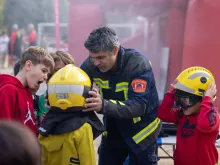
Fire Prevention Week is a long-running public awareness and preparedness initiative promoted by Fundación MAPFRE in collaboration with Spanish fire brigades and local authorities. Implemented annually across multiple cities since 2006, the initiative brings fire safety knowledge directly to citizens through open days at fire stations, public demonstrations, hands-on workshops, and educational activities for schools and families. Its core aim is to reduce domestic and urban fire risk by translating professional fire-safety practices into practical, everyday behaviours.
Map
Fire Prevention Week (Semana de la Prevención de Incendios)
General Information
A nationwide, recurring fire-risk awareness and prevention campaign that uses experiential learning and direct interaction with firefighters to improve household preparedness and reduce fire-related injuries and damage.
Spain records thousands of residential fires every year, many linked to preventable causes such as unsafe electrical installations, misuse of heaters, kitchen accidents, and lack of smoke detectors. Prior to the launch of Fire Prevention Week, fire-safety education was fragmented and largely reactive. Fundación MAPFRE, drawing on its prevention mandate and partnerships with emergency services, created a proactive, citizen-centred programme to embed a culture of fire prevention, particularly targeting families, children, and older adults.
Hazard Type
Geographical Scope - Nuts
Geographical Scope
Population Size
Population Density
Needs Addressed
Low public awareness of everyday fire risks and limited practical knowledge on prevention, early detection, and correct behaviour during a fire emergency, particularly in domestic settings.
Children are addressed through school-oriented activities and interactive demonstrations, while older adults are targeted with guidance on home safety, heating appliances, and evacuation behaviour, recognising their higher vulnerability to smoke inhalation and mobility constraints.
The initiative is coordinated by Fundación MAPFRE and implemented locally through agreements with municipal fire brigades, city councils, and sometimes regional civil protection bodies, combining private foundation leadership with public emergency services.
Fire Prevention Week does not manage emergencies but strengthens preparedness by improving citizens’ understanding of alarms, evacuation, and first response actions, complementing formal fire-service readiness.
Spain is equipped with developed infrastructure, especially in urban setting where the initiative takes place, and is also able to use this infrastructure to respond to fire emergency - this include fire stations, road infrastructure, public squares and established emergency infrastructure which doesn't require new assets
To create direct communication between citizens and firefighters, enabling exchange where residents can ask questions, discuss real risks in their homes, and receive tailored advice.
Engagement is achieved through open days at fire stations, live fire-extinguisher demonstrations, evacuation simulations, educational games for children, guided tours of emergency vehicles, and face-to-face discussions with professional firefighters and prevention specialists.
Participants do not influence the design of the programme but actively shape their own preparedness by identifying risks in their homes and adopting recommended prevention measures discussed during activities.
The initiative builds long-term resilience by normalising fire-safe behaviours, increasing familiarity with emergency procedures, and strengthening citizens’ confidence to act correctly in early-stage fire situations.
Governance
Emergency Preparedness
Infrastructure Readiness
Engagement Level
Empowerment Level
Implementation
A distinctive feature is the experiential, hands-on approach: citizens learn directly from firefighters in real operational settings. The annual repetition across cities allows messages to be reinforced over time and adapted to local risk profiles.
Spanish
Fundación MAPFRE, in partnership with municipal fire brigades and local authorities.
Fundación MAPFRE has extensive experience in prevention and safety education through long-standing programmes on road safety, health, and emergency risk reduction, while partner fire brigades contribute operational expertise.
Municipal fire brigades, local governments, schools, families, volunteers, and Fundación MAPFRE staff.
The programme is planned annually with selected host cities; public activities are designed with fire brigades; communication campaigns invite citizens; events are delivered over several days; feedback and participation figures are collected for future editions.
Human resources from firefighters and educators, communication materials, safety equipment for demonstrations, and logistical support from municipalities. Financial costs are covered primarily by Fundación MAPFRE with in-kind contributions from public partners.
Fire Prevention Week is held annually, typically over one week per host city, with planning and evaluation cycles repeated every year since 2006.
Experience of the Implementing Organisation in DRM
Target Audience
Resources Required
Timeframe & Phases
Participation Results
Reaching diverse audiences in urban settings is challenging; maintaining engagement year after year
Risks of low engagement are mitigated by locating activities in highly visible public spaces and tailoring content for different age groups, together with hands-on activities.
Risk & Mitigation Plan
Scalability and Sustainability
The programme is sustained through Fundación MAPFRE’s long-term prevention strategy and recurring partnerships with fire services, allowing continuity without dependence on short-term project funding.
The model is highly replicable in other countries or cities with established fire services, as it relies on existing infrastructure and adaptable educational formats.
Technology plays a secondary role, mainly through communication materials and occasional digital dissemination, with emphasis placed on in-person learning.
Direct costs include event logistics, educational materials, communication campaigns, and coordination staff.
Operational costs recur annually and relate to staff time, materials renewal, and local event organisation.
Direct interaction with emergency professionals significantly increases trust and retention of safety messages. Experiential learning proves more effective than passive information campaigns in changing household behaviours.