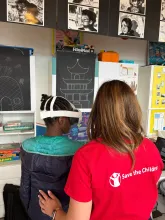
Feel Safe VR Experience is a virtual reality-based learning program designed to educate children and adolescents about disaster preparedness and risk management. The project simulates real-life emergency scenarios, such as earthquakes, floods, and wildfires, within a safe and controlled environment, allowing participants to practice decision-making, problem-solving, and teamwork. By integrating immersive technology with educational and social protection objectives, the program promotes community engagement, experiential learning, and resilience-building, while providing educators with tools to reinforce safety awareness in schools and local communities.
Map
Feel Safe VR Experience
General Information
Save the Children Italia
Feel Safe VR Experience is an immersive educational project by Save the Children Italia that uses virtual reality to teach children and adolescents how to respond safely to emergencies. Through interactive simulations of earthquakes, floods, and wildfires, participants develop practical safety skills, resilience, and awareness. The project emphasizes participation, inclusivity, and engagement to foster responsible young citizens.
Feel Safe VR Experience was developed by Save the Children Italia within the broader Feel Safe initiative, in response to the vulnerability of children and communities to natural hazards such as earthquakes, floods, and wildfires. The tool addresses gaps in traditional safety education by providing an immersive, experiential learning environment where children can practice emergency response in a safe and controlled way. Its development reflects the organization’s commitment to child protection, disaster risk reduction, and resilience-building, leveraging virtual reality to engage students and complement educational programs in schools and local communities.
Needs Addressed
Children and adolescents are often vulnerable to natural hazards such as earthquakes, floods, and wildfires, especially in regions where schools and communities may lack preparedness plans, safety education, or resilient infrastructure. Traditional classroom-based safety education can be abstract, disengaging, and insufficient to develop real-life skills, leaving young people unprepared to respond effectively in emergencies. Additionally, there is a need to build resilience, awareness, and proactive behaviors among children while fostering community engagement and safe collaboration. Feel Safe VR Experience addresses these gaps by providing an immersive, interactive, and safe learning environment where children can experience simulated emergencies, practice decision-making, and internalize correct behaviors to better cope with real-world risks.
Feel Safe VR Experience targets children and adolescents, particularly those in hazard-prone or underserved areas, providing them with immersive learning to build safety awareness and resilience. The tool is designed to be inclusive, addressing children with disabilities, learning difficulties, or limited access to educational resources, while also supporting teachers and educators in guiding these vulnerable students.
Feel Safe VR Experience assumes basic to moderately developed school infrastructure and strengthens it through immersive, practical emergency preparedness training, making students and staff more ready to respond safely in real emergencies.
The tool focuses on active interaction between students and the VR scenarios, allowing learners to make decisions, practice behaviors, and receive feedback. While teachers and educators are involved, the primary engagement is student-centered learning through immersive dialogue with the simulation, rather than full partnership with external stakeholders.
Feel Safe VR Experience engages children and adolescents through immersive virtual reality simulations that place them directly in realistic emergency scenarios such as earthquakes, floods, and wildfires. Participants actively interact with the environment, make decisions, and experience the consequences of their actions in a safe, controlled setting, promoting experiential learning and practical skill development. Educators guide students before, during, and after the VR sessions, facilitating reflection and discussion to reinforce key safety messages. Collaborative group activities encourage communication, cooperation, and shared responsibility, while the inclusive design ensures accessibility for children of different abilities and backgrounds.
In Feel Safe VR Experience, students actively interact with VR simulations of emergencies, such as earthquakes, floods, or wildfires. Their choices within the simulations directly affect outcomes, allowing them to practice safe behaviors, problem-solving, and responsibility in a controlled environment. This provides a strong sense of agency and helps them internalize the consequences of their actions.
Feel Safe VR Experience contributes to capacity-building and long-term empowerment by equipping children and adolescents with practical skills, knowledge, and confidence to respond safely in emergencies. Through immersive VR simulations, participants develop resilience, decision-making abilities, and problem-solving skills that extend beyond the classroom, fostering a proactive mindset toward personal and community safety.
Hazard Type
Geographical Scope - Nuts
Geographical Scope
Population Size
Population Density
Vulnerable Groups
Governance
Emergency Preparedness
Engagement Level
Empowerment Level
Implementation
Feel Safe VR Experience represents an innovative approach to disaster education by combining immersive virtual reality technology with experiential, learner-centered pedagogy. Unlike traditional classroom-based safety lessons, it allows children and adolescents to actively engage with realistic emergency scenarios—such as earthquakes, floods, and wildfires—making decisions and experiencing consequences in a safe, controlled environment. A key innovation is its inclusive design, which ensures accessibility for children with diverse abilities, learning styles, and needs, including those with physical, cognitive, or sensory challenges.
English, Italian, French, Spanish
Save the Children Italia
Save the Children Italia has a high level of experience in Disaster Risk Management (DRM), particularly in supporting children during emergencies. More specifically, the work of the Emergecy Unit of Save the Children Italia spans all DRM phases: mitigation and prevention through disaster-risk education, preparedness via training and planning, response with immediate aid and psychosocial support, and recovery through safe spaces, education continuity, and child protection. They have extensive experience in national emergencies, such as the 2016–2017 Central Italy earthquakes, and collaborate closely with civil protection authorities. Additionally, they develop practical manuals and toolkits for frontline staff, demonstrating their capacity to translate DRM principles into actionable interventions for children in both acute and longer-term emergency contexts.
Actors involved include:
- Children and adolescents : main participants engaging with VR simulations.
- Teachers and educators: facilitate sessions, provide guidance, and lead reflection.
Implementation steps include:
- Identify schools and students; assess infrastructure; consult disability organizations; train educators.
- Configure VR scenarios; implement accessibility features; set up VR equipment.
- Conduct guided simulations; facilitate reflection and discussion; promote collaborative exercises.
- Embed VR into curricula; provide reinforcement activities; collect feedback from participants and educators.
- Track engagement and learning outcomes; assess inclusivity; refine content and delivery for future scaling.
Feel Safe VR Experience requires a sustainable mix of internal and external resources. Internally, it relies on schools, teachers, and educators to facilitate sessions and integrate the program into curricula. Externally, it depends on VR equipment, such as headsets and laptops.
Experience of the Implementing Organisation in DRM
Target Audience
Resources Required
Timeframe & Phases
Participation Results
Risk & Mitigation Plan
Scalability and Sustainability
Feel Safe VR Experience leverages immersive virtual reality technology to provide real-time decision-making, interactive environmental responses, and scenario branching, giving students immediate feedback on their actions. Its accessibility features—including adjustable visual, auditory, and interactive elements—ensure that children with physical, cognitive, or sensory challenges can fully participate. The system is scalable and integrable with classroom infrastructure, supporting group exercises, guided facilitation by educators, and post-session reflection. Together, these technological elements create a safe, adaptive, and highly engaging learning environment that enhances traditional safety education.
The main direct costs involve the initial setup and development of the VR program. This includes purchasing VR hardware such as headsets, controllers, and sensors, with a small classroom set (4–5 headsets) costing roughly €1,500–€2,000. Custom software development and scenario programming (including emergency simulations and accessibility features) can range from €13,000 to €50,000, depending on complexity. Content customization for local hazards, training for educators, and consultancy with disability organizations may add €3,000–€5,000.
Operational costs technical support and maintenance, often estimated at 15–20% of the initial setup cost annually. Educator facilitation, consumables such as hygiene covers for VR headsets, and minor hardware replacements may add about €1,000 per year. Monitoring and evaluation of learning outcomes could also require a modest recurring budget depending on scope.