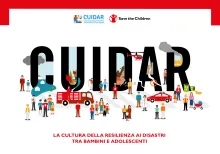
The manual reports on the CUIDAR project (Horizon 2020), aimed at strengthening disaster resilience by involving children and adolescents as active contributors. It outlines the project’s approach, which combines participatory learning, dialogue with institutions, and community-based activities carried out across five European countries. The publication highlights how young people’s local knowledge, perspectives, and creative input can enhance disaster preparedness and improve communication and cooperation between communities and civil protection systems.
Map
CUIDAR - La cultura della resilienza ai disastri tra bambini e adolescenti
General Information
Save the Children Italia
This manual presents the results of the work carried out within the CUIDAR project (Horizon 2020), focused on promoting a disaster resilience culture that actively includes children and adolescents. The manual documents activities conducted in Italy, Spain, Portugal, Greece, and the United Kingdom, showing how young people are not only vulnerable subjects but can also become key actors in disaster prevention, preparedness, and response.
The program involved more than 500 young people through participatory workshops, laboratory activities, field explorations, and moments of dialogue with institutions and civil protection authorities. The participants shared their perceptions, needs, local knowledge, and ideas on how to improve safety, prevention, and risk communication.
Disasters such as floods, earthquakes, and wildfires increasingly challenge communities across Europe. Children and adolescents are often seen as vulnerable, yet international frameworks emphasize their potential role in disaster risk reduction. The CUIDAR project was developed to explore how children and adolescents can actively participate in building a culture of resilience. Implemented in Italy, Spain, Portugal, Greece, and the United Kingdom, the project aims to bridge the gap between youth perspectives and institutional emergency planning. It promotes participatory methods that give young people a voice, allowing them to express concerns, share local knowledge, and co-design solutions with civil protection authorities.
Needs Addressed
Children and adolescents are often considered passive victims in disaster situations and are rarely involved in planning, prevention, or preparedness strategies. This lack of inclusion limits the effectiveness of disaster risk reduction and community resilience, as young people’s perspectives, local knowledge, and potential contributions remain underutilized.
Children are vulnerable in disasters due to their developmental needs and limited decision-making power. CUIDAR emphasizes their unique perspectives and capacities, engaging them actively to strengthen community resilience and promote a child-centred approach to disaster preparedness and risk reduction.
The CUIDAR project adopts a multistakeholder governance approach by engaging children, adolescents, educators, NGOs, and civil protection authorities in collaborative activities. This ensures that diverse perspectives and expertise contribute to disaster resilience planning and implementation. At the same time, the project is community led, as local communities and young participants actively shape workshops, discussions, and preparedness initiatives. Combining multistakeholder collaboration with community-led participation allows the project to integrate institutional knowledge with local insights, creating more effective, inclusive, and sustainable resilience strategies.
The manual focuses on raising awareness, building knowledge, and developing participatory skills among children and adolescents. It emphasizes understanding risks, prevention measures, and community engagement rather than implementing formal disaster response plans.
The CUIDAR manual emphasizes knowledge-building, awareness, and participatory engagement rather than physical or technical infrastructure. Its focus is on enabling children, adolescents, and communities to understand risks, adopt preventive behaviors, and contribute to resilience planning. While some existing community structures may support these activities, the manual does not address the development of advanced or resilient infrastructure systems.
The CUIDAR manual goes beyond simply providing information to children and adolescents; it actively involves them in the project through consultation and partnership. Participants contribute their perceptions, local knowledge, and ideas during workshops and community activities, which are then used to inform disaster preparedness and resilience strategies. In some cases, young people collaborate directly with educators, NGOs, and civil protection authorities, reflecting elements of shared decision-making. This combination of consultation and partnership ensures that children are recognized as active contributors rather than passive recipients.
The CUIDAR manual employs a variety of participatory methods to engage children and adolescents in disaster resilience. These include workshops and laboratory activities that explore risks, prevention, and preparedness, as well as community-based projects such as field visits and local initiatives that connect learning to real-world contexts. The project also facilitates dialogue with civil protection authorities, educators, and NGOs, allowing young participants to share their perceptions, ideas, and feedback. In some cases, children and adolescents take part in collaborative co-design activities, helping to create awareness campaigns, educational materials, or community initiatives. Informal learning methods, such as peer discussions and interactive exercises, complement these approaches to ensure active participation and meaningful engagement.
In the CUIDAR manual, children and adolescents exercise a consultative and participatory influence by sharing their perceptions, ideas, and local knowledge during workshops, community activities, and consultations with educators and civil protection authorities. In certain activities, they also engage in collaborative decision-making, co-designing awareness campaigns, educational materials, and community initiatives. While they do not hold full authority over formal disaster planning, this approach ensures that their voices meaningfully inform and shape project outcomes, reinforcing their role as active contributors to community resilience.
The CUIDAR manual promotes capacity-building by equipping children and adolescents with knowledge, skills, and participatory experience related to disaster preparedness, risk prevention, and community resilience. Through workshops, consultations, and collaborative projects, young participants develop practical skills, critical thinking, and confidence to engage in local resilience initiatives. By fostering understanding, involvement, and collaboration, the methodology provided in the manual supports long-term empowerment, enabling young people to contributing to disaster risk reduction and to act as informed, proactive members of their communities.
Hazard Type
Geographical Scope - Nuts
Geographical Scope
Population Size
Population Density
Vulnerable Groups
Governance
Emergency Preparedness
Infrastructure Readiness
Engagement Level
Empowerment Level
Implementation
The CUIDAR manual introduces several innovative approaches to child-centred disaster resilience. Its key features include participatory workshops and community-based activities that actively involve children and adolescents in understanding risks and co-designing solutions. The manual emphasizes multistakeholder collaboration, bringing together young people, educators, NGOs, and civil protection authorities to integrate local knowledge with institutional expertise. Additionally, it provides practical tools, guidelines, and methodologies for engaging youth in resilience-building, promoting awareness, consultation, and collaborative action. By positioning children as active contributors rather than passive recipients, the manual represents a novel approach to fostering long-term community preparedness and empowerment.
English
Save the Children Italia
Save the Children Italia has a high level of experience in Disaster Risk Management (DRM), particularly in supporting children during emergencies. More specifically, the work of the Emergecy Unit of Save the Children Italia spans all DRM phases: mitigation and prevention through disaster-risk education, preparedness via training and planning, response with immediate aid and psychosocial support, and recovery through safe spaces, education continuity, and child protection. They have extensive experience in national emergencies, such as the 2016–2017 Central Italy earthquakes, and collaborate closely with civil protection authorities. Additionally, they develop practical manuals and toolkits for frontline staff, demonstrating their capacity to translate DRM principles into actionable interventions for children in both acute and longer-term emergency contexts.
The actors involved include:
- Children and Adolescents: primary participants, providing insights, local knowledge, and co-designing initiatives.
- Educators and Schools: facilitating workshops, guiding learning activities, and supporting participation.
- Non-Governmental Organizations (NGOs): particularly Save the Children, coordinating the project, providing expertise, and supporting implementation.
- Civil Protection Authorities / Emergency Services: engaging in dialogue, sharing knowledge, and integrating youth input into preparedness strategies.
- Community Members / Local Stakeholders: supporting activities, providing local context, and participating in consultations and community-based projects.
Implementation steps include:
- Identify local hazards, community needs, and existing preparedness measures.
- Develop participatory workshops and community-based activities tailored to the local context.
- Conduct workshops, field visits, and co-design activities with children and adolescents.
- Involve educators, NGOs, and civil protection authorities to integrate youth input into preparedness strategies.
- Capture lessons learned, feedback, and provide guidance for replication and long-term capacity building.
A combination of human, financial, institutional, material, and knowledge resources is required. Human resources include educators, facilitators, project coordinators, community volunteers, and experts from NGOs or civil protection authorities to guide and support participatory activities. Financial resources cover workshop materials, transportation, venue costs, and budgets for coordination, documentation, and evaluation. Institutional support from schools, educational institutions, and local authorities is essential to provide access, venues, and integration into local preparedness efforts. Material and technical resources such as interactive learning tools, visual aids, communication equipment, and optional digital tools enhance engagement and learning. Finally, access to the CUIDAR manual, guidelines, and templates for consultations, feedback, and co-design exercises ensures that the methodology can be implemented effectively and adapted to different local contexts while maintaining its participatory, child-centred approach.
The CUIDAR manual follows a structured framework composed of distinct, sequential phases. It begins with context analysis, assessing local hazards, community needs, and existing preparedness measures. This is followed by planning and designing participatory activities, including workshops and community-based projects tailored to local contexts. The next phase focuses on youth engagement, where children and adolescents actively contribute ideas, knowledge, and feedback. Simultaneously, stakeholder dialogue with educators, NGOs, and civil protection authorities ensures that youth input informs preparedness strategies. The final phase emphasizes documentation and reflection, capturing lessons learned and providing guidance for replication, creating a coherent, stepwise approach that can be adapted across different settings.
Experience of the Implementing Organisation in DRM
Target Audience
Resources Required
Timeframe & Phases
Participation Results
The implementation of the activities conducted during the CUIDAR project highlighted several key lessons. First, children and adolescents can be active contributors to disaster preparedness when given structured opportunities to participate. Second, participatory, community-based approaches are effective in integrating local knowledge with institutional expertise, enhancing both engagement and relevance. Third, flexibility and adaptation are crucial, as different communities and age groups require tailored methods and activities. Finally, strong collaboration between schools, NGOs, civil protection authorities, and local communities is essential to ensure sustainability, replicate activities, and embed a culture of resilience over the long term. These lessons demonstrate that child-centred, participatory strategies can strengthen preparedness and community resilience across diverse contexts.
Implementing the CUIDAR methodology involves several challenges, including engaging diverse groups of children with varying ages, abilities, and backgrounds, ensuring meaningful participation, and coordinating multiple stakeholders across different countries and communities. Limited resources, logistical constraints, and varying local contexts can also pose difficulties. To address these challenges, adaptive strategies can be employed, such as flexible workshop designs tailored to local needs, participatory methods that accommodate different learning styles, and strong collaboration between schools, NGOs, civil protection authorities, and community members. Continuous reflection, feedback collection, and iterative adjustments ensure that activities remain inclusive, relevant, and effective while fostering youth empowerment and long-term community resilience.
The manual emphasizes tailored approaches to engage children and adolescents in understanding and preparing for local disaster risks. Activities are designed to address specific hazards relevant to each community, with participatory workshops and consultations adapted to local contexts.
Risk & Mitigation Plan
Scalability and Sustainability
The CUIDAR manual promotes sustainability by combining institutional support, community engagement, and youth empowerment. Activities are integrated within schools and local communities, ensuring that knowledge, skills, and participatory practices continue beyond the project’s lifespan. Collaboration with NGOs, civil protection authorities, and local stakeholders provides ongoing technical support and resources, while training educators and facilitators builds long-term capacity.
The CUIDAR methodology is designed to be both scalable and adaptable across different contexts. Its structured framework, participatory workshops, and community-based activities can be replicated in various countries, regions, or schools, regardless of local hazards or community size. Activities and materials are flexible, allowing facilitators to tailor workshops, engagement methods, and co-design exercises to suit the age, background, and abilities of children and adolescents. Collaboration with local stakeholders ensures that the approach can be adapted to cultural, geographic, and institutional differences, making it a versatile model for promoting child-centred disaster resilience in diverse settings.
The manual primarily presents and relies on participatory, educational, and community-based methods, with minimal use of digital or advanced technological tools. Some optional use of presentations, videos, or simple digital tools may enhance engagement, but technology is not central to the methodology.
The main direct costs for implementing the CUIDAR methodology include materials and supplies for workshops (e.g., paper, pens, boards, visual aids), transportation for field visits and community activities, and venues if not provided by schools or community centers. Additional direct costs may include printing educational resources, minor equipment for interactive exercises, and stipends or fees for facilitators if external personnel are involved. These costs are relatively modest and can often be covered using local budgets or small grants.
Operational costs for implementing the CUIDAR methodology include coordination, planning, and management of workshops and community activities. This covers staff or facilitator time, scheduling and organizing sessions, stakeholder communication, and monitoring and documentation of activities and outcomes. Additional operational costs may include minor expenses for logistical support, such as coordinating transportation, ensuring accessibility for participants, or maintaining materials over multiple sessions. While not as substantial as direct costs, these operational costs require careful planning to ensure smooth execution and continuity, particularly when replicating the methodology across different schools or communities.
Sustainable and scalable child-centred disaster preparedness is best achieved by using local resources like schools, educators, and community volunteers, minimizing reliance on external support. Training local facilitators ensures activities continue beyond the initial implementation, while flexible, adaptable methods allow workshops and participatory activities to fit different ages, communities, and hazard types. Integrating activities into school curricula or community programs, fostering collaboration with NGOs and local authorities, and documenting tools and lessons learned all support replication, long-term continuity, and broader adoption of the approach.