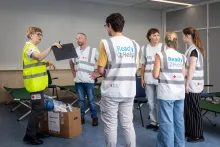
Ready2Help is a platform built around registering and deploying (spontaneous) volunteers in the Netherlands. Those who sign up through Ready2Help are considered part of the Ready2Help network. Ready2Helpers are (typically) untrained citizens, who wish to volunteer on a flexible basis. What this means is that Ready2Helpers can choose whether or not to join an activity when this fits with their schedules. The deployment of Ready2Helpers is coordinated by the Netherlands Red Cross. These deployments are typically in short intervals, Ready2Helpers are generally matched with deployments that take place in their local area. Anyone from the age of 18 and up, who lives in the Netherlands, has a (Dutch) phone number and email address can sign up as a Ready2Helper. Citizens do not need to follow any special training or courses, nor do they need to be equipped with a particular skill set. Ready2Help is intended for everyone.
It is important to keep in mind that Ready2Helpers have not signed a formal volunteer agreement with the Red Cross. Nor have they received any professional training from the Netherlands Red Cross. As a result, the deployment of Ready2Helpers is not suitable for all types of emergency response activities. The deployment of Ready2Helpers requires additional considerations as opposed to the deployment of formally registered Red Cross volunteers
Map
Ready2Help
General Information
Professional emergency services may, at times, be limited in their response capacity and are often forced to focus their efforts on providing only the most essential assistance. Ready2Help is especially beneficial when a large number of people are quickly needed to provide extra support. This includes physical assistance (e.g. filling sandbags, carrying goods), sheltering groups of people, relieving healthcare personnel or providing assistance by making resources available (e.g. places to sleep or means of transport). The Netherlands Red Cross coordinates the deployment of Ready2Heleprs alongside the professional emergency services. In principle, Ready2help is a support service which is only activated in addition to the deployment of the Netherlands Red Cross's formal volunteers. However, it may happen that only Ready2Helpers are deployed, in which case a trained team leader from the Netherlands Red Cross will always be present for guidance and coordination.
In the event of a disaster, citizens are usually the first to take action to help their fellow citizens. Channeling and organizing citizen assistance is an integral part of the activities of the Red Cross. On April 17th in 2014, at the Red Cross conference 'Power to the People', the decision was made to establish Ready2Help in the Netherlands, following the Austrian example: a network of citizens who are not trained as volunteers but are willing to take voluntary action when a disaster requires it and the Netherlands Red Cross is able to coordinate it. Ready2Help has now become an integral part of the Netherlands Red Cross's emergency response services. In major crises, such as the refugee crisis in 2015, the COVID-19 pandemic in 2020, and the Ukraine refugee influx in 2022, a growing number of people indicated their willingness to volunteer for the Netherlands Red Cross as Ready2Helpers.
Hazard Type
Geographical Scope - Nuts
Population Size
Population Density
Needs Addressed
The Netherlands has a multi-level and integrated Disaster Risk Management (DRM) governance structure, with a shifting focus from a reactive emergency response structure to more proactive risk reduction and climate adaptation strategies. This system is built on consensus-oriented administrative arrangements, often referred to as the "polder model," especially concerning centuries-old water management practices.
Well connected infrastructure, communication, and support network accross the country.
The Netherlands Red Cross engages stakeholders through Ready2Help to mobilize individuals who are willing to assist in emergency situations but do not wish to commit to long-term or formal volunteer roles. Research on volunteer engagement shows that this group represents a significant potential resource, and Ready2Help responds by offering a flexible, low-commitment form of participation. Through this solution, the Netherlands Red Cross engages Ready2Helpers as a distinct stakeholder group alongside formal volunteers, with the objective of expanding response capacity while maintaining alignment with the organization’s humanitarian principles. Their deployment is coordinated based on regional needs and calls for additional personnel, and they sign up only for tasks they choose, allowing this form of engagement to coexist with and reinforce traditional volunteer structures while preserving flexibility and autonomy.
Ongoing engagement of the Ready2Help network can be a challenge, as large numbers of individuals sign up during crises when willingness to help peaks, followed by periods of lower activity in which Ready2Help is deployed less frequently. During these periods of low activity, Ready2Helpers may feel like they are unable to contribute in a meaningful way. To address this, the Netherlands Red Cross is exploring various forms of assistance that were previously not part of the typical deployment repertoire. These considerations are being incorporated into the Ready2Help communication plan that is currently under development. In addition, ongoing engagement is sustained through regular newsletters that update Ready2Helpers on the activities of the Netherlands Red Cross. Aside from the ongoing maintainance of the Ready2Help network, the Netherlands Red Cross continues to invest in their information sharing with partner organizations such as waterboards, and participates in joint training activities that strengthen the relationship with partner organzations.
The types of activities that Ready2Helpers can deploy for are predetermined; Ready2Helpers do not choose this on the spot. Tasks are assigned based on agreements with the requesting partner and the Netherlands Red Cross. In addition, spontaneous volunteers must first register (via app or on paper), receive instructions, and are placed where their skills fit best.The deployment of Ready2Helpers must be safe and must not hinder professional emergency services. Tasks must be feasible for untrained citizens with only brief on-site instruction. Group deployments are always supervised by a team leader. One team leader supervises a maximum of ten Ready2Helpers. In cases of small deployments (for example two Ready2Helpers), if there is a shortage of team leaders, coordination may be carried out by a Red Cross volunteer, professional or coordinator of the person requesting assistance, provided that they follow the correct briefing and this has been reported to the Ready2Help team.
Ready2Helpers always work in pairs (according to the four-eyes principle), and both persons must be affiliated with the Red Cross. The region of deployment must have sufficient capacity for proper preparation and coordination of the deployment. Ready2Helpers do not perform tasks that give them access to personal or medical data, and they are not deployed for psychosocial assistance or guidance to medical facilities. Deployment must be in line with the wishes of the Ready2Helper: temporary, short (max. 6 hours per shift), within reasonable travelling distance and without further commitment. Ready2Help is supplementary, which means the network is activated only in the event of a capacity shortage among regular volunteers. Tasks must contribute directly to providing assistance; no fundraising or similar activities.
There is an evaluation after every deployment for the Ready2Helpers that were deployed. In addition, every once in a while, the Netherlands Red Cross has large-scale evaluations for all the registered Ready2Helpers.
Ready2Helpers are assumed to act in good faith, even without formal background checks, and always work in pairs. This trust-based approach underpins all current and future Ready2Help activities. Beneficiaries can distinguish between volunteers and Ready2Helpers as they are recognisable by their different uniforms. This is reinforced through national onboarding and deployment materials. Through digitalization, the Red Cross aims to better map Ready2Helpers’ talents and interests (e.g. language skills, medical or logistical expertise). This information will be stored in systems linked to volunteer administration and accessible via an app, enabling targeted deployment and outreach.
Vulnerable Groups
Governance
Emergency Preparedness
Infrastructure Readiness
Engagement Level
Empowerment Level
Implementation
Anyone aged 18 or older can join Ready2Help without prior skills, experience, or long-term commitment. The network attracts a relatively young demographic in comparison to formal volunteers. Ready2Helpers support the relief activities of the Netherlands Red Cross. Ready2Helpers are covered by the Netherlands Red Cross's insurance during relief activities. Ready2Helpers are only deployed under safe conditions and are not deployed if they may be in danger or have to take major risks. Ready2Helpers are not deployed in the acute phase of a disaster or calamity, but in the phase before or after.
The unique selling points (USPs) of the Ready2Help citizen assistance network are that it is:
• Flexible
• Hands on
• Capable of swift deployment
• Meant for short-term relief efforts
• A network that provides the opportunity for people to respond when a crisis or disaster occurs
• A network that can make sure that more people are assited during a crisis or disaster
Dutch
The Netherlands Red Cross.
The Netherlands Red Cross is highly experienced in disaster risk management and response.
The Netherlands Red Cross.
Deployment of Ready2Help is in response to requests for assistance from (chain) partners or other parties (group deployment).
Ready2Help: group deployment
If the emergency response activity complies with the national guidelines for established emergency response activities and the deployment of Ready2Help fits within the outlined framework, the region is permitted to fill out the Ready2Help deployment request form. A separate work instruction is available for the regions, detailing all the steps that need to be taken to send the call to Ready2Helpers. Team Ready2Help at the main office sends the call-up email on behalf of the region to a (large) group of Ready2Helpers in the vicinity of the deployment based on the information provided on the application form, and the corresponding services are opened up for Ready2Helpers in the Tools2Go app. The region confirms the registered Ready2Helpers and provides instructions for the deployment.
Implementation of Ready2Help deployment in a group setting:
Ready2Helpers must be properly supervised by a trained team leader on site before and during the deployment. Ready2Helpers wear a Ready2Help vest during group assignments. Ready2Helpers must be 18 years of age or older for insurance reasons. Date of birth will be requested upon registration. Minors cannot be registered or deployed.
Ready2Helpers can be called up in two ways:
• By e-mail, with registration in on an online platform taking place beforehand
• Via iTel, with registration in an online platform taking place afterwards.
Settlement of Ready2Help deployment in group deployments:
Any issues or problems concerning the Ready2Helpers deployed will be dealt with within the local office if possible, or otherwise reported. It is important for the Assistance and Quality department to be aware of the various assistance activities that are initiated by the regional offices. A Ready2Help deployment must be registered in an app in the same way as other aid activities. This is also important for sending the evaluations to the Ready2Helpers deployed afterwards.
For each relief activity, the relevant guideline specifies which costs, where applicable, the Netherlands Red Cross may charge to the requesting organisation or client (including cooperation with water boards). Ready2Helpers do not receive any remuneration from the Red Cross, including travel expenses, unless a local office makes different arrangements with the client in exceptional cases. Ready2Helpers currently do not use the expense claim app; any related costs are borne by the local office. The Red Cross does not currently charge an hourly rate per deployed Ready2Helper. A local office may, however, invoice the client for the hours worked by Ready2Helpers. Consideration is being given to introducing an hourly rate in the future, potentially including travel expenses. Once a decision is made, this framework will be updated
The solution is maintained during the cold phase and activated during incidents per request.
Experience of the Implementing Organisation in DRM
Target Audience
Resources Required
Timeframe & Phases
Participation Results
What has been learned is that the willingness to help in the Netherlands is high. The approach is strongly driven by current events, which is also reflected in peaks in deployments. One key lesson is that clear frameworks are essential, but that not everything fits neatly into black-and-white categories. It is also important to establish and maintain strong relationships in advance. During the Limburg floods, for example, local contacts had grown cold, which made coordination more difficult. Keeping these connections warm is therefore crucial. Extensive data, figures, and evaluations have been collected. Post-COVID, the number of deployments has increased significantly. The model has proven scalable and effective as support to professional emergency services. The low-threshold and the flexible nature of Ready2Help is a major contributor to its success.
A key difficulty is finding the right balance between centralised and decentralised decision-making. The Netherlands Red Cross aims to decentralise the deployment of Ready2Helpers and to give more responsibility to local branches. While a centralised Ready2Help approach means more control and more unity in decision-making, it also takes longer to actually deploy Ready2Help during a crisis. Another challenge is that a local team will already be operating on site. Yet they are not responsible for the deployment of Ready2Help. This can be a barrier for management, which results in hesitation towards activating Ready2Help. Decentralisation might tackle this, but it might also result in activation of Ready2Help outside of the existing Red Cross framework (i.e., how we want something to operate).
Some actors find it difficult to involve Ready2Helpers because of how Ready2Helpers are not required to undergo a background check. This can be a barrier as the coordinating actors bear responsibility over the Ready2Helpers. Other reasons for scepticism is not knowing if and how many people will show up as they do not have a commitment to do so and not knowing their competence and skills beforehand.
When deploying Ready2Helpers, the Red Cross has a responsibility to ensure good working conditions. Team leaders play a role in ensuring these good conditions in the field. It is, however, not always easy to ensure safe conditions while working in a crisis situation. Besides that, follow-up and possibilities for (for example) pscyosocial support are important but also more difficult when the group of people is not as attached to the organisation as formal volunteers.
To address these challenges, the Netherlands Red Cross focuses on developing a forward-looking vision for Ready2Help, better aligning activities with helpers’ interests and competencies, strengthening ICT systems and app functionality, and placing greater emphasis on preparedness rather than solely on deployment.
The greatest risks surrounding the deployment of Ready2Help is deploying them for tasks that are not suitable for them.
Example 1:
Risk and description: Inability of Ready2Helpers to provide proper care
Cause: Ready2Helpers are deployed for an activity that is not suitable for Ready2Helpers
Consequence: The person requesting assistance suffers personal injury
Control measure: Deployment must be approved in advance by the Ready2Help department and must fit within existing frameworks.
Example 2:
Risk and description: Personal safety of emergency responders Ready2Helpers are not properly supervised by a team leader and therefore do not perform tasks, perform them poorly or perform them incorrectly.
Cause: Insufficient capacity of team leaders
Consequence: Dissatisfaction among R2H volunteers, tasks are not performed properly or tasks for which they are not competent or authorised are performed. The person requesting assistance may suffer personal injury or their privacy may be violated.
Control measure:
1. Temporary policy that coordinators can also manage
2. RK volunteer or coordination from the client
3. Train Ready2Helpers and team leads so that there is sufficient capacity .
Risk & Mitigation Plan
Scalability and Sustainability
Maintaining the relationship with Ready2Helpers is difficult in the long-term. People sign up en masse during times of crisis, and many feel compelled to volunteer. After a period in which the network is called upon extensively, there is often a period in which Ready2Help is used less frequently. It can also happen that people have been members for years without ever receiving a call or being able to respond to one. This requires good expectation management and a careful communication strategy. If people feel that they cannot fulfill their need to help in a crisis situation through Ready2Help, this poses a reputational risk. At the same time, the immediate willingness of so many people to do something at that moment also offers many opportunities for forms of assistance that would otherwise not be possible. All these issues are taken into account in the Ready2Help communication plan.
Further development:
Registering skills: The Red Cross wishes to further develop the Ready2Help network and increase the quality of the network through the registration of both competencies and interests of Ready2Helpers. Currently, the Netherlands Red Cross does not ask helpers about their skills and resources, e.g. medical skills or access to a boat. It is also useful to check the location of the helpers. In addition, the Netherlands Red Cross wishes to explore new ways of communicating with the Ready2Help network to ensure deployment when needed and to keep in touch in 'quieter' times, and finally, the Netherlands Red Cross is working on expanding existing local initiatives with other non-profit organisations. Some interesting partners are Food Banks for the distribution of food parcels, and the Salvation Army in assisting with sheltering homeless people.
Comparable solutions exist in different countries. Ready2Help is inspired by ‘Team Österreich’, a similar solution provided by the Austrian Red Cross. In Denmark, the Red Cross use something similar, but involving only highly skilled professionals. Countries have their own set up depending on the focus of the Red Cross in that country.
Spinoff exercises are also a good way of maintaining the continuity of Ready2Help and for its continued development. Team Ostenreich, on which Ready2Help is based off of, frequently conducts small-scale try-outs and new forms of community engagement and local aid. Such as, Team Ostenreich Tafel and Team Ostenreich Digitial.
Ready2Helpers themselves do not generate revenue, costs are incurred but no fee is charged for their involvement. Only team leaders incur a charge. The organization is exploring whether compensation for the deployment of Ready2Helpers by requesting organization or client could be introduced through government channels.
Ready2Help originated in 2014 with start-up funding from the Ministry of Justice and Security. Since then, the model has mostly operated cost-neutral, with partnerships (e.g., municipal crisis management, water authorities) helping cover expenses.