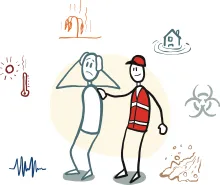
The ‘Emergency Awareness’ workshops offer a practical, community-based way to strengthen readiness for high impact crisis scenarios by turning abstract risks into relatable, actionable choices. Rooted in real world hazards, the workshops show how everyday decisions can reduce vulnerability and speed up recovery when systems are strained. Their interactive format makes preparedness tangible, helping participants understand not only what they can do for themselves but also how mutual support shapes community resilience. Because the approach is accessible, low tech and adaptable, it resonates with diverse groups and can be transferred to different national or local DRM contexts.
Map
Emergency awareness workshops
General Information
The 'Emergency Awareness' Workshops aims to strengthen people and community preparedness in crises and emergencies. The workshops are designed to align preparedness activities with crises that have a high likelihood and high societal impact: hazardous materials incidents, flooding, extreme weather, blackouts, epidemics and wildfires. The workshops use an interactive, small group serious game to introduce concrete preparedness actions. Participants jointly prepare a fictional persona for an upcoming crisis and later reflect on what these actions mean for their own situation. This design lowers thresholds for participation, encourages active learning, and promotes a mindset of mutual support which is an important component of community resilience.
The ‘Emergency Awareness’ workshops were developed in response to the growing urgency that many people in the Netherlands are insufficiently prepared for emergencies, disasters and crises. Research shows that a significant portion of the population has low risk awareness and lacks the basic knowledge, skills, or tools to act independently in the critical first moments of a crisis. At the same time, the Red Cross observes that people in vulnerable situations are often out of reach of regular communication channels.
Geographical Scope - Nuts
Population Size
Population Density
Needs Addressed
The target group of the workshops are people who are frequently overlooked in risk communication, including elderly, people with limited literacy, migrants with limited language proficiency and individuals with restricted digital access. To reach these groups, workshops are delivered through local partner organisations already embedded in the community. Materials rely heavily on images and spoken facilitation rather than digital tools, ensuring accessibility for participants with low digital literacy.
In the Netherlands, infrastructure readiness is a key part of Disaster Risk Management. Because the country is vulnerable to flooding, storms and potential disruptions to essential services, it invests in keeping critical systems strong and dependable. This includes maintaining dikes and water barriers, as well as making sure roads, bridges, power networks and communication systems can withstand emergency situations. These systems must function properly during a crisis so emergency services can respond quickly, people can evacuate safely and essential services remain available. This involves regular risk assessments, continuous monitoring, emergency planning and strong cooperation. Public awareness and participation are still limited compared to institutional preparedness.
Stakeholder involvement in creating the Geen Nood workshops is multi-layered and continuous, combining expertise from product managers, crisis analysts, instructional designers, regional coordinators, trained volunteers, community partners, and the target groups themselves. Each contributes insights that shape the workshop’s content, accessibility and real world relevance.
- Scenario selection is based on risk analyses carried out by crisis management experts, who consolidate security region risk profiles into Red Cross relevant scenarios.
- Instructions, game flow and accessibility were tested and informed by the target group.
- An instructional designer were involved to ensure the workshop supports learning goals, uses accessible language and offers effective behaviour change elements.
- Local partners identify needs, request workshops and help reach communities that are hard to engage through official channels. Their input shapes what themes are most useful and should be prioritised.
- Trained volunteers play a key role in both shaping and delivering the workshops. New insights often emerge from their experience in the field. Materials are adapted when recurring challenges arise. Volunteers also test materials during training and provide feedback to refine content and logistics.
- Municipalities or local organisations request a workshop because they see a need among their residents. These requests indirectly influence how often they are given and which scenarios receive most attention.
The interest in the workshops comes from the local level (the community). The way informtion is shared during the workshop is centered around the expressed needs and interest of the people present. Evaluation relies on end of session surveys that measure learning and intended actions, supplemented by pilot testing with target groups. While no long term tracking is conducted, insights have led to adjustments such as simplifying instructions and emphasizing facilitator training.
Vulnerable Groups
Governance
Emergency Preparedness
Infrastructure Readiness
Engagement Level
Empowerment Level
Implementation
- Individual preparedness (kits, plans, home safety)
- Community support (workshops and volunteers)
- Information and education (training, scenario exercises)
The Netherlands Red Cross
The Netherlands Red Cross has been at the forefront of the global shift from reactive disaster response toward anticipatory, risk-informed action. It actively promotes managing risks rather than disasters, aligning its approach with the Sendai Framework and EU DRM priorities, including preparedness, prevention and early action.
As an auxiliary to public authorities, the Netherlands Red Cross operates in close alignment with Dutch safety regions and national crisis frameworks. Its crisis preparedness, scenario planning and netcentric coordination models are explicitly designed to complement governmental DRM systems, making its experience relevant for institutional resilience and governance discussions.
The organisation combines national-level DRM engagement with community-based preparedness, focusing on awareness, self-reliance and inclusion of vulnerable groups. The resilience and preparedness approach demonstrates how risk communication and local capacity building can reduce cascading impacts during crisis and emergencies.
Strategic review: Assess target groups, relevance and alignment with organisation’s strategy (focus on emergency aid, disasters and crises).
Portfolio decision-making:
- Decide which activities to stop, continue or develop.
- Select workshop options based on high probability and/or high impact (crisis analysis).
Target group & partners:
- Define the appropriate target groups.
- Workshops are delivered at partner locations; partners already have access to the target audience. Create or activate your network.
Volunteers & roles:
- Two trained workshop facilitators per workshop.
- Define explanation, guidance and serious game facilitation.
Training (train-the-trainer):
- Training by experts on resilience and preparedness of people in vulnerable positions, often together with the regional coordinators
- Allows flexible scaling with small participant numbers.
Materials & logistics:
- Availability of workshop materials (serious game).
- On average, 4 game sets per region so that different groups can run simultaneously. Larger or more active regions may have additional sets.
Workshop delivery:
- Workshop takes place at the partner’s location.
- Delivered by two volunteers using the game-based materials.
1. Human Resources
- Volunteers/Workshop Leaders: Trained facilitators to conduct interactive workshops, guide exercises and engage participants.
- Coordinators/Organisers: Staff or volunteers responsible for planning workshops, liaising with local organisations, scheduling sessions and managing logistics.
- Support Personnel: Assistants for distributing materials, handling registration and providing on-site support.
2. Material Resources
- Workshop Materials: Handouts, printed guides, scenario cards, games and visual aids for interactive sessions.
- Emergency Preparedness Tools (optional): Examples of emergency kits (flashlights, batteries, bottled water, first aid kits) for demonstration purposes.
- Digital Tools: Tablets, laptops, projectors, or screens to present information, apps for first aid guidance or interactive exercises.
- Facilities: Room or space in community centres, schools or social organisations to hold workshops.
Experience of the Implementing Organisation in DRM
Target Audience
Resources Required
Timeframe & Phases
Participation Results
- Mobilising volunteers: It can be challenging to recruit enough volunteers to get the workshops started.
- Complexity of the game: The game includes quite a lot of explanation, which can make it difficult to follow.
- Balancing simplicity and learning impact: Simplifying the game may reduce its learning effect, while complexity can exclude some participants.
- Serving multiple target groups: Designing one game for different audiences risks it being too easy for some and too difficult for others.
- Strong dependence on the facilitator: The effectiveness of the workshop largely depends on how well the facilitator adapts to the group.
- Language and audience differences: Participants with limited language proficiency require extra attention and adaptation to stay engaged.
Risk & Mitigation Plan
Scalability and Sustainability
The workshops are implemented by trained volunteer facilitators, supported by a Train the Trainer system and standardised materials. Regional teams host sessions at partner locations, maintain sets of physical game kits and handle local coordination. A modest fee for host organisations covers facilitator time and material costs.
The workshops provide a scalable, low tech preparedness format that can be adapted to other countries by using a relevant hazard scenario, translating materials and partnering with trusted local organisations. Its emphasis on accessible communication, practical action and collective readiness makes it relevant for disaster risk management and community resilience practitioners in diverse contexts.
The solution itself is an on-site workshop. The activity does include technology during the presentation in the form of PowerPoint slides.
The costs for staff involved in managing, organising and presenting the workshops and the costs of promoting the workshops and hosting the workshops (on site or at a different venue).
It is important to have support from a colleague (or colleagues) with social design and design thinking skills. There needs to be support from the organisation, but also interest from the community for the topics you are communicating on.