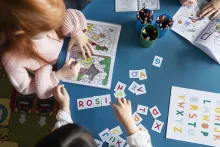
RisKIT is an educational and playful kit developed by Save the Children Italy to promote a culture of safety and awareness of children’s rights. Through interactive activities and games, it helps children and adolescents recognize natural hazards in their area, understand the role of Civil Protection, and learn how to prepare for emergencies, fostering awareness and resilience.
Map
RisKIT
General information
Save the Children Italia
RisKIT is an educational game designed for primary schools that combines learning and fun to raise awareness among children about environmental risks and prevention measures. It includes practical exercises such as creating a risk calendar and an emergency kit, while also integrating knowledge of children’s rights in crisis situations. The goal is to develop collaboration and responsibility skills from an early age.
RisKIT was developed in response to the growing need for integrating safety education and resilience-building into curricula, particularly in areas exposed to natural hazards. By combining playful learning with practical knowledge, RisKIT helps children understand local risks, recognize the role of civil protection systems, and prepare for emergencies in an engaging and age-appropriate way. This approach ensures that children remain informed, prepared, and active participants in their own safety, even in challenging situations.
Status
Purpose
Topics For Preparedness
Hazard Type
Geographical Scope - Nuts
Geographical Scope
Population Size
Population Density
Needs Addressed
RisKIT tackles the lack of child-focused disaster risk education in schools, which often results in low awareness and preparedness among children and communities. Many schools do not have integrated risk management plans or practical tools to teach safety and resilience in an engaging way.
The primary vulnerable group is children in school settings, who often lack access to structured disaster risk education. By targeting this group, RisKIT helps reducing vulnerability and promotes resilience from an early age.
The tool is designed for contexts where there is some awareness of risks but no advanced systems in place. It does not require an organized emergency response structure to be effective. It is not dependent on advanced preparedness or complex protocols; rather, it helps build foundational knowledge and behaviors.
RisKIT can be implemented in standard classroom settings without specialized infrastructure. A developed or advanced resilient infrastructure is not necessary, though having safe school facilities enhances its impact.
RisKIT aims at capacity building and empowerment by increasing knowledge, practical skills, and confidence in managing risks. It also strengthens community ties by involving schools and families in preparedness efforts.
RisKIT allows children and educators to interact through structured activities, discussions, and collaborative exercises, fostering active participation rather than passive learning.
Children have moderate influence within the classroom context as they contribute ideas and actions that shape school-level preparedness activities, fostering a sense of agency.
RisKIT builds foundational skills and knowledge that can evolve into long-term resilience. By embedding risk awareness in early education, it creates a culture of preparedness that benefits communities over time.
Vulnerable Groups
Governance
Emergency Preparedness
Infrastructure Readiness
Engagement Level
Empowerment Level
Implementation
Play‑based learning provides an engaging foundation for teaching risk awareness and emergency preparedness, using interactive games to help children understand how to stay safe. Built on a multi‑hazard approach, the program introduces students to a range of natural hazards so they can recognize different threats rather than focusing on just one. Its child‑centered design ensures that even complex ideas are presented in ways that primary school students can easily grasp. By integrating principles from the UN Convention on the Rights of the Child, the approach also emphasizes children’s right to safety, participation, and information. Collaborative activities, including creating risk calendars and assembling emergency kits, further strengthen learning by encouraging teamwork and shared problem‑solving.
Italian
Save the Children Italia
Save the Children Italia has a high level of experience in Disaster Risk Management (DRM), particularly in supporting children during emergencies. More specifically, the work of the Emergecy Unit of Save the Children Italia spans all DRM phases: mitigation and prevention through disaster-risk education, preparedness via training and planning, response with immediate aid and psychosocial support, and recovery through safe spaces, education continuity, and child protection. They have extensive experience in national emergencies, such as the 2016–2017 Central Italy earthquakes, and collaborate closely with civil protection authorities. Additionally, they develop practical manuals and toolkits for frontline staff, demonstrating their capacity to translate DRM principles into actionable interventions for children in both acute and longer-term emergency contexts.
The actors involved include:
- Educational Institutions: primary actor imlementing the tool.
- General Public: families indirectly engaged through children’s activities.
Implementatio steps include:
- Distribute the RisKIT materials to schools and train teachers on how to use them.
- Explain the objectives and activities to students.
- Conduct interactive sessions (risk mapping, kit building, rights discussion.
- Involve students in creating a risk calendar and emergency kit.
- Discuss lessons learned and reinforce key messages.
- Embed activities into school safety plans and curricula for sustainability.
RisKIT primarily relies on local schools and educators for implementation. It does not require heavy infrastructure or continuous external funding, but some external support (e.g., initial training) might be necessary.
RisKIT follows a clear sequence: preparation, engagement, collaboration, reflection, and integration into school safety plans. It includes defined steps and objectives, but it does not require long-term monitoring or complex evaluation systems.
Experience of the Implementing Organisation in DRM
Target Audience
Resources Required
Timeframe & Phases
Participation Results
Early engagement of teachers and school leadership is essential for integrating RisKIT effectively into school activities. The use of play-based learning has proven to significantly boost retention and participation compared to traditional methods, making preparedness education more engaging for children. Schools that customized activities to reflect local hazards achieved greater impact, demonstrating the importance of contextual relevance. Furthermore, linking disaster preparedness to children’s rights creates a holistic approach that embeds safety education within broader well-being and protection frameworks.
RisKIT faces challenges such as limited teacher training, uneven school resources, and the need to keep children engaged while addressing serious topics. To adapt, it uses simple, modular activities that fit into existing curricula, playful methods to sustain interest, and guidance for local customization. Partnerships with civil protection agencies further ensure relevance and effectiveness.
RisKIT is designed to address multiple types of hazards (earthquakes, floods, landslides, wildfires) rather than focusing on one. Its activities teach general preparedness principles that apply across scenarios, making it adaptable and comprehensive.
Risk & Mitigation Plan
Scalability and Sustainability
RisKIT relies on a school-based integration model, where activities are embedded into existing curricula and supported by local educators. This approach ensures continuity without requiring constant external intervention. Sustainability is achieved through teacher training and modular resources that can be reused annually.
RisKIT has high scalability and adaptability because it uses simple, low-cost materials and flexible content that can be tailored to different hazards and cultural contexts. It can be replicated across schools and regions with minimal adjustments.
RisKIT is primarily a physical, play-based tool rather than a tech-driven solution. While innovative in its educational approach, it does not incorporate advanced technologies or smart adaptive systems.
Direct costs include printing and distribution of RisKIT materials and initial teacher training sessions.
Operational costs include minimal recurring costs such as teacher time for implementation and occasional refresh of materials. No significant infrastructure or technology expenses are required.
Sustainability and impact depend on early engagement and local ownership. When teachers and school leadership are involved from the start, integration into curricula becomes smoother and long-lasting. Simple, modular design and low-cost materials make the tool scalable and adaptable across diverse contexts, while play-based methods ensure high participation and retention. Linking preparedness to children’s rights not only strengthens relevance but also embeds risk education within a broader well-being framework. Finally, fostering partnerships with local civil protection agencies enhances contextualization and builds trust, proving that collaboration is essential for resilience and continuity.