
In emergency situations, the rights of children and adolescents risk being violated, ignored, or underestimated due to the need to intervene quickly on aspects related to primary needs. Based on experience gained internationally and in national emergency contexts, Save the Children Italia offers practical recommendations to ensure safety, educational continuity, psychological support, and child participation, emphasizing respect for children’s rights and strengthening community resilience.
Mountainous
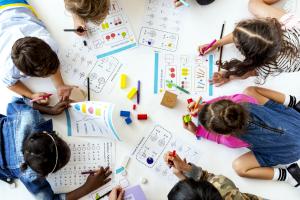
This manual represents a practical and concrete support to all operators working in emergency settings in carrying out educational activities with children and adolescents in emergency situations.
Due to its sudden nature, an emergency disrupts and significantly alters the daily life and linearity of educational interventions. It is therefore crucial to restore routine and the psycho-physical well-being of the children involved.
Solution
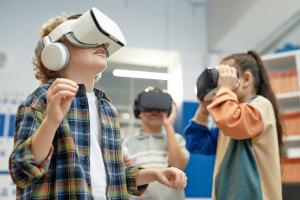
Feel Safe VR Experience is an immersive educational project by Save the Children Italia that uses virtual reality to teach children and adolescents how to respond safely to emergencies. Through interactive simulations of earthquakes, floods, and wildfires, participants develop practical safety skills, resilience, and awareness. The project emphasizes participation, inclusivity, and engagement to foster responsible young citizens.
Solution
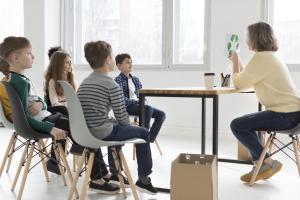
The project consists of three structured workshops: Explore (building awareness of risk and resilience through storytelling and games), Experience (role-playing emergency scenarios to practice safe behaviors), and Participate (hands-on engagement via VR or the dynamic team game “Corri il Rischio”). The initiative equips children with practical skills for emergency preparedness and fosters collaboration, decision-making, and climate crisis awareness, positioning Feel Safe as a pioneering model for integrating technology and education in resilience-building.
Case
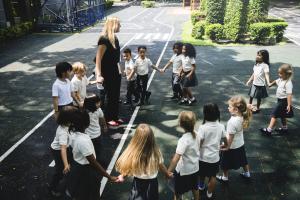
The toolkit is aimed at school disaster management, risk prevention, and community awareness. It contains three integrated parts, which are a Participatory School Disaster Management handbook, a school disaster management plan form templates for school use and annual review, and student & community participatory activities.
It is designed to be updated over time (ring-binder approach) and adapted to different contexts.
Solution
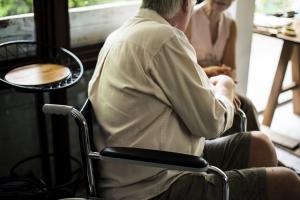
The case illustrates how disability-inclusive DRR has been advanced in Vanuatu by shifting from ad-hoc inclusion to more systematic engagement of persons with disabilities and their representative organisations in preparedness, response planning, and community decision-making.
Case
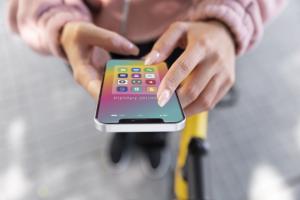
Safety tips combines a traveler-focused safety website and a push-alert smartphone app to help people in Japan react quickly during hazards.
It provides multilingual alerts (e.g., earthquake/tsunami/weather) and practical guidance such as evacuation flowcharts and helpful phrases for communicating locally.
The emergency section organizes procedures to follow for multiple scenarios (earthquake, tsunami warnings, evacuation information, volcanic warnings, heat stroke alerts).
Solution
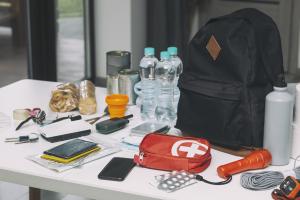
Get Ready (NEMA - New Zealand) is a national preparedness platform that offers practical instructions for preparing for and responding to multi-risk emergencies (before, during, and after).
The site addresses the problem of low self-sufficiency in a crisis, promoting family/community plans, kits, and supplies (e.g., water and grab bags). It includes specific guidance for vulnerable groups (disabilities, the elderly, children) and pets, with accessible and multilingual resources.
Case
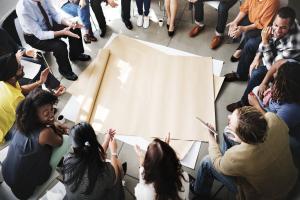
The CiVà Project – Engaged Citizenship, Active Volunteering was developed with the aim of updating the Municipal Civil Protection Plan of the Municipality of Lucca, in accordance with the National and Regional law, through a participatory process involving citizens, institutions, associations, economic operators, and schools.
Case
A nationwide, recurring fire-risk awareness and prevention campaign that uses experiential learning and direct interaction with firefighters to improve household preparedness and reduce fire-related injuries and damage.
Case