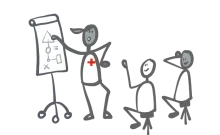
The goal of a Life Skills workshop is to teach and improve skills that help participants better protect their own (mental) health. The workshop is intended for all migrants, including undocumented migrants, and asylum seekers.
Workshop topics:
- Access to healthcare
- Clear communication
- Stress Management
- Healthy habits
- Looking ahead, Using your Talents
- Know your (labour) rights
Map
Life Skills Workshops
General Information
Netherlands Red Cross
Life Skills is a series of low-threshold workshops by the Netherlands Red Cross supporting migrants, asylum seekers, and undocumented people by providing them with practical skills, boosting their self-reliance, and creating a safe and open space to discuss challenges and concerns with peers.
The program was launched in response to the increasing mental health challenges faced by (undocumented) migrants and their access to health care. These rising concerns sparked broader discussions about how to reduce the mental health issues affecting these groups. To address the problems early and prevent them from worsening, the Netherlands Red Cross launched the Life Skills workshops. These workshops focus on tackling various factors that can negatively impact the well-being and mental health of (undocumented) migrants.
Hazard Type
Geographical Scope - Nuts
Population Size
Population Density
Needs Addressed
The main focus of the Life Skills workshops is undocumented migrants. Groups that are also supported are refugees, asylum seekers, EU labor migrants, homeless migrants, and women (digital-skills workshops).
The Netherlands has strong institutional preparedness, but marginalized groups are often overlooked in official DRM. Public crisis awareness remains low, and undocumented migrants are rarely included in preparedness strategies. The Netherlands Red Cross solution addresses this gap through practical and psychosocial preparedness training.
Culturally appropriate support, trust-building, co-development of activities.
Participants influence activity formats, language, cultural adjustments, and level of involvement. Activities are adapted to cultural needs (e.g., alternative roles for those uncomfortable with specific exercises).
At the end of each workshop, participants receive a handout that summarize the content of the workshop, as well as links to relevant resources. For example, in the healthcare workshop they receive information about how to find a general practitioner, as well as websites with additional guidance on the Dutch healthcare system. They are also given links to free self‑care applications, such as Insight Timer. In addition, they are referred to other helpful Red Cross programs, including the WhatsApp helpline; a website that lists available services for undocumented migrants. All of these resources are distributed at the end of the workshop.
Vulnerable Groups
Governance
Emergency Preparedness
Infrastructure Readiness
Engagement Level
Empowerment Level
Implementation
The workshops provide a safe space for the migrants to learn but also share their worries and challenges with peers. Through the Life Skills workshops they can receive emotional support from other participants and the trainers. The trainers are either experienced practitioners or have a background in mental health/medical care.
The workshops are provided in the participants own language. The trainers can speak multiple languages like English, Dutch, Somali, Arabic and a trainer will be assigned to a workshop who can speak the native language of the participants or the training will be done with the help of a translator provided by the partner organization. The topics chosen are relevant to the needs of the participants, the topics might appear simple but they are needed. For example migrants are vulnerable to human trafficking and exploitation. While the Netherlands Red Cross cannot help find these jobs, they do help them to avoid risks of human trafficking and exploitation and access proper help if they are victims of Human trafficking.
The workshop trainers can speak a wide range of languages such as: Spanish, Arabic, English, Farsi English, Dutch, and Arabic. The Netherlands Red Cross always asks the partner organization what languages they need (the workshop to be taught in). If there are no volunteers that speak the required language then the Netherlands Red Cross asks the partner organization if they can help to provide a translator (a colleague, participant, or volunteer that works with the partner organization). The training materials and the facilitator’s guide for the trainer is in English but the handouts for the participants are provided in their language.
Netherlands Red Cross.
Netherlands Red Cross staff & registered Netherlands Red Cross volunteers. Partnered with the: Central Agency for the Reception of Asylum Seekers in the Netherlands (COA), the Netherlands Council for Refugee Work (VWN – VluchtelingenWerk Nederland), the municipalities and many NGOs like salvation army and ASKV.
The workshops are facilitated by Netherlands Red Cross volunteers. These volunteers are trained by the Netherlands Red Cross to deliver the workshops. These volunteers typically have a background in mental health/medical care, have experience in working with migrants and experience in facilitating workshops.
Each Life Skills workshop lasts approximately two hours and takes place at the location of the partner organization. The workshops follow a semi structured format that includes group work, practical exercises, and guided discussions, all facilitated by the trainer(s). For example, in the stress management workshop, participants receive an outline or image of a human body. The trainer(s) asks them to indicate where they feel (physical) stress symptoms. If someone experiences shaking or hand tremors, for instance, they may mark the drawn hands. Afterwards, the group compares symptoms and is taught about the different ways in which stress can manifest itself (not only physically but also emotionally and mentally).management workshop, participants receive an outline or image of a human body. The trainer
At the end of each workshop, the handouts will be given to the participants which contains summary of the workshop and more resources on the topic for example in the access to healthcare workshop, links to the general practitioner and websites with more information on finding doctors and the healthcare system or in the stress management workshop there are links to free self-care application, such as ‘Insidetimer’. There are also other programs within the Netherlands Red Cross that might help them, such as the WhatsApp Helpline or HIA. The latter is a website that lists all the services for undocumented migrants. These information are included in the hand outs.
Brochures/promotion: The Netherlands Red Cross creates and distributes Life Skills Workshop brochures. A promotion short video is also produced that will be send to partner organization to know more about the workshop.
Workshop Materials: the workshops typically use print-outs, paper, pens, and depending on the type of workshop there would need to be workshop specific cards, pictures, and handouts.
Trained Volunteers: In every region where the Life Skills Workshops are given there are at least ten trained Netherlands Red Cross volunteers. These volunteers also need to be trained in advance to provide the workshops.
The training for workshop facilitators is comprised out of several components. First, volunteers receive a handbook, a trainer’s guide, and a set of training materials and resources to help them familiarize themselves with the workshop content. They also complete six e‑learning modules that prepare them for working with the Netherlands Red Cross, covering topics such as privacy and confidentiality, the principles of the Red Cross, undocumented migrants, the healthcare system in the Netherlands, and human trafficking.
Next, volunteers participate in a one‑day in‑person training. This training allows them to meet other volunteers, learn about the mission and goals of the program, and take part in practical exercises that demonstrate how workshops are facilitated. The program relies heavily on the existing knowledge and experience of volunteers, supported by the manuals and guides provided.
Finally, each workshop is facilitated by a duo: one experienced trainer paired with a new volunteer. This ensures quality, builds confidence, and helps new trainers learn directly through practice.
The Netherlands Red Cross creates and distributes Life Skills Workshop brochures to the partner organizations and spread the word. These brochures list the types of workshops and skills taught during the workshops. Those who are interested in the Life Skills Workshops can reach out directly via the contact details in the brochures or contact the Netherlands Red Cross regional office, the regional office will then send the request through to the main office. Requests typically come in from partners of the Netherlands Red Cross who are directly in contact with the target groups. Partners can indicate which workshops they would like to host and Who the participants or beneficiaries are. The regional offices forward these requests to the program coordinator. After which the program coordinator helps to facilitate in the organization of the workshops.
Experience of the Implementing Organisation in DRM
Target Audience
Resources Required
Timeframe & Phases
Participation Results
Building trust in the participants of the workshops is essential. Psychosocial and practical support is a key outcome of the workshops and you can not achieve this goal if you do not build the trust of the participants. It is important to be sensitive to the needs of the participants and be creative and flexible during the workshops in communicating with them and also facilitating the discussions. Sometimes this means adjusting the approach, style, or structure of the workshop.
One challenge is that the workshops are organized, but when the time comes participants may not all show up. Partners might register ten people, yet only five attend, and cancellations from partner organizations are common.
At other times, participants do arrive, but they speak several different languages within the same room, not all Arabic or English for example, which makes it difficult to continue the workshop as planned. It is often not possible to cancel last‑minute, but carrying on in these cases can also be quite challenging. In some cases, Google Translate might be used or someone who speaks the required language is asked to sit with a small group and assist with quiet translation.
Another challenge is volunteer turnover. Many of the volunteers are students or individuals seeking employment. When they complete their studies or find a job, they often leave the program, which results in a relatively high turnover rate.
Because of these realities, volunteers must be flexible and creative in finding solutions. The Netherlands Red Cross prepares them by explaining that situations may differ from their expectations. Migrants’ lives can be unpredictable and unstable, and the workshops, and the approach, must reflect that in a supportive and adaptable way.
The Netherlands Red Cross evaluates the effect of the Life Skills workshops through feedback forms. Three feedback forms are fill out: One by the participants and One by the trainers at the end of each workshop. The third is filled out by the partner organizations at the end of each workshop serie to collect comments and suggestions from the partner organization. The Netherlands Red Cross also conducts impact surveys every six to twelve months. For these surveys participants are selected from previous Life Skills Workshops and contacted via their mobile numbers that were registered in the attendance list during each workshop. These surveys include questions about the skills participants learned during the workshops and how they used them in their actual life
Risk & Mitigation Plan
Scalability and Sustainability
The first five workshops were developed in consultation with IFRC Psychosocial Support Reference Center and some other National societies. The Netherlands Red Cross consulted with psychologists, when creating the initial workshop formats and topics. The new Life Skills workshop, ‘Know Your Rights’, was developed by antihuman trafficking department as a result of observations and input from the field that an increasing amount of migrants are exploited. It was added to the list of life skills topics as we give the workshop to the same target group.