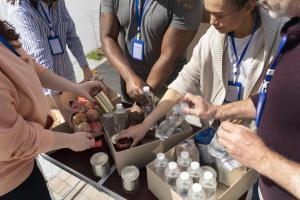
The Disaster Recovery Toolkit for Local Government is a modular guide that helps local authorities prepare for, manage, and sustain disaster recovery across the full recovery timeline.
Crisis / Risk Communication
A free, curriculum-linked first aid teaching toolkit that enables any secondary school teacher across the UK to deliver first aid education to students.
Contribution

The Tokyo Resilience Project is a city-wide preparedness programme that equips residents with practical tools and learning experiences to improve everyday disaster readiness.
In practice, the project operates as a multi-hazard resilience “umbrella”: it strengthens physical protection (e.g., regulating reservoirs and river measures; coastal protection and sea-level-rise readiness; upgrading buildings and lifelines) while also trying to make preparedness “everyday” through accessible products and outreach. Examples of public-facing outputs include:
Case
Provides emergency managers and disaster preparedness professionals with practical, step-by-step guidance for designing and conducting simulation exercises that test and strengthen response plans, procedures, and coordination systems across all hazards.
Contribution
An annual Italian programme that trains young people each year in disaster risk awareness and civil protection through immersive week-long camps.
Contribution
A free, modular resilience guide that equips Red Cross Red Crescent branches and community-based organisations in urban areas to lead practical, low-cost activities that strengthen community preparedness and reduce disaster risk.
Contribution
A comprehensive digital solution that equips residents and visitors of Estonia with standardized, actionable instructions to prepare for and respond to a wide array of crises, from natural disasters to cyber-attacks. The platform features an interactive household supply checklist, first-aid instructions, and survival guidelines tailored to the Estonian context. Its mobile application is designed to function entirely offline once downloaded, ensuring that citizens have uninterrupted access to life-saving information even during severe power or telecommunications outages.
Contribution
A global educational simulation that challenges players to act as disaster risk managers, tasking them with protecting communities against imminent natural hazards through strategic planning and resource management. In each 10-20 minute session, players navigate one of five scenarios - tsunami, hurricane, wildfire, earthquake, or flood - where they must decide how to spend a limited budget on structural and non-structural measures.
Contribution
A comprehensive national communication initiative designed to provide Romanian citizens with standardized, life-saving behavioral guidelines for seismic events. The initiative utilizes high-visibility video spots, downloadable educational brochures for schools, and interactive digital content to replace common myths with scientifically backed "correct behaviors." By ensuring that every citizen knows how to "drop, cover, and hold on" and avoid dangerous actions like using elevators or running onto stairs, the campaign builds a culture of national seismic resilience.
Contribution
A digital platform and citizen network designed to mobilize local mutual aid and risk awareness through a "Citizen Volunteer" model before, during, and after disasters.
Contribution