A two-year pilot in which seven US neighbourhoods worked home by home to reduce wildfire risk, with most households taking part.
Rural
A five-step method for building flood early warning systems with local communities, municipalities and national weather and civil defence services in the Andes.
It was developed by CIIFEN, the International Research Centre on El Niño, under the regional programme PRASDES, which Finland’s foreign ministry financed. It joins the four components of early warning set out by the UN disaster-reduction office to an approach of the Organization of American States in which trained community volunteers operate simple rain and river-level instruments.
Contribution
In 2015-2016, residents of 19 communities in Escoma, Bolivia, mapped flood-prone areas with the municipality to build a local flood early warning system.
Contribution
A community flood early warning system was built in Querecotillo, Peru, in 2016, with residents mapping flood zones and rehearsing an evacuation drill. CIIFEN worked with the municipality, the civil defence institute INDECI and the weather service SENAMHI between January and September 2016.
Contribution
Residents of two flood-prone communities in Chad described how they already warn each other and prepare for floods, and what support they want.
Contribution
In November 2023, communities in Butaleja and Mbale, Uganda, dug drainage ditches and reinforced flood barriers before forecast floods, supported by the Uganda Red Cross Society.
Contribution
Before the 2024/25 drought season, farmers in Mbire, Zimbabwe, helped plan and build water and livestock protection measures with Welthungerhilfe and its local partner.
Contribution
Suryodaya connects neighbourhood organisation with municipal disaster risk governance. Its 201 Tole Development Committees support preparedness and community mobilisation, working with ward and municipal authorities. Participatory assessment and planning connect local knowledge with technical risk analysis and municipal action.
Contribution

A free, curriculum-linked first aid teaching toolkit that enables any secondary school teacher across the UK to deliver first aid education to students.
Case
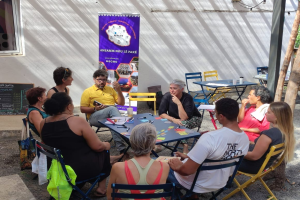
Cette démarche s’inspire de l’expérience québécoise du Regroupement des Organismes Humanitaires et Communautaires pour les Mesures d’Urgence à Montréal (ROHCMUM). Les outils de préparation aux situations d’urgence développés par l’AFPCNT, associés à des ateliers collectifs, permettent aux associations réunionnaises volontaires de réaliser leur Plan de mesures d’urgence et de solidarité.
Contribution