
Provides emergency managers and disaster preparedness professionals with practical, step-by-step guidance for designing and conducting simulation exercises that test and strengthen response plans, procedures, and coordination systems across all hazards.
50.000 - 200.000

A policy and planning toolkit used by education and disaster risk management actors to assess, reduce, and manage risks affecting learners, educators, and education systems. The solution outlines foundations and pillars for systemic action to protect learners, keep schools open during crises, and build resilience through risk education and inclusive safety management.
The CSSF aims to:
Solution

A comprehensive digital solution that equips residents and visitors of Estonia with standardized, actionable instructions to prepare for and respond to a wide array of crises, from natural disasters to cyber-attacks. The platform features an interactive household supply checklist, first-aid instructions, and survival guidelines tailored to the Estonian context. Its mobile application is designed to function entirely offline once downloaded, ensuring that citizens have uninterrupted access to life-saving information even during severe power or telecommunications outages.
Solution

The solution provides ready-to-use, scenario-based materials that help organisations simulate cyber incidents and strengthen their response coordination and decision-making capacity. The packages include facilitator guides, scenario narratives, injects, and evaluation tools that enable organisations to conduct structured discussion-based exercises without requiring technical simulation infrastructure.
Solution

A community-based educational board game that helps participants learn about natural hazards, preparedness actions, and response behaviours relevant to island environments. It is supported by a structured facilitator manual to ensure accurate learning outcomes.
The solution aims to increase disaster risk awareness and preparedness through interactive learning, enabling participants to recognise local hazards, understand appropriate preparedness actions, and discuss risk-reducing behaviours relevant to Seychelles island communities.
Solution

A board-game-based educational toolkit that helps children understand hazards and disaster risk reduction through interactive gameplay and structured learning activities.
Solution
A printable, facilitator-led game that teaches teenagers practical safety behaviours for floods and wildfires through riddles, cooperative mini-games, and a debrief discussion.
The toolkit places participants in a scenario where they have 30 minutes to support a local councillor by identifying “good practices” for protecting people and reducing risk. It is designed for group play (4–6 participants) with an adult activity leader and ends with a structured debrief to consolidate learning.
Solution

A primary-school preparedness programme that teaches children what to do in emergencies through interactive lessons and an online game.
Developed by the National Crisis Centre, the programme consists of downloadable interactive teaching kits structured in three levels (aligned with primary education learning objectives), parent brochures to extend learning at home, and a web-based game (“BE-Ready”) that lets pupils practice choices under time pressure in simulated emergencies.
Case

This handbook is a practical tool designed to help educators in Malta teach children and adolescents about disaster preparedness—especially earthquakes—through engaging, inclusive, and age-appropriate activities. Based on the Feel Safe methodology developed by Save the Children Italy, it offers a structured learning pathway (Explore–Experience–Participate), ready-to-use exercises, and guidance on addressing both the technical and emotional dimensions of emergencies.
Solution
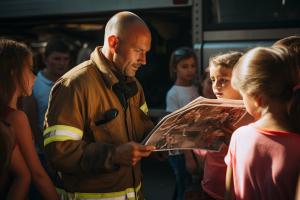
A modular fire safety education programme for secondary schools that helps teachers build students’ practical knowledge and safer behaviour.
BFireSafe@School provides structured learning content (units/modules) supported by digital components (e-learning/LMS), enabling schools to integrate fire safety into classroom delivery in a consistent and repeatable way. It was developed through a multi-country consortium and is made available in multiple languages to support transferability across education systems.
Case